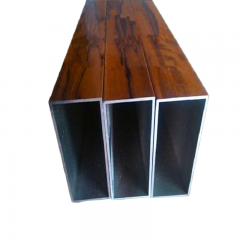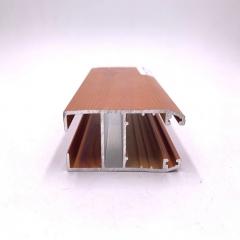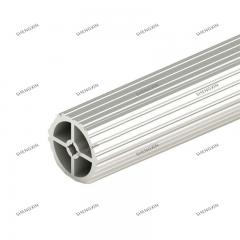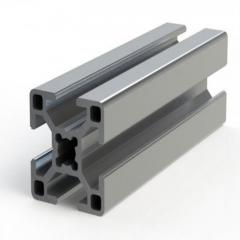
When you hear "airfoil," you probably think of airplane wings. That same aerodynamic principle shows up in aluminum extrusion profiles used across architecture and industry. But what exactly makes a profile an airfoil, and why does that shape matter for your project?
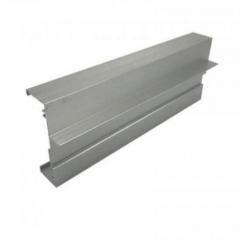
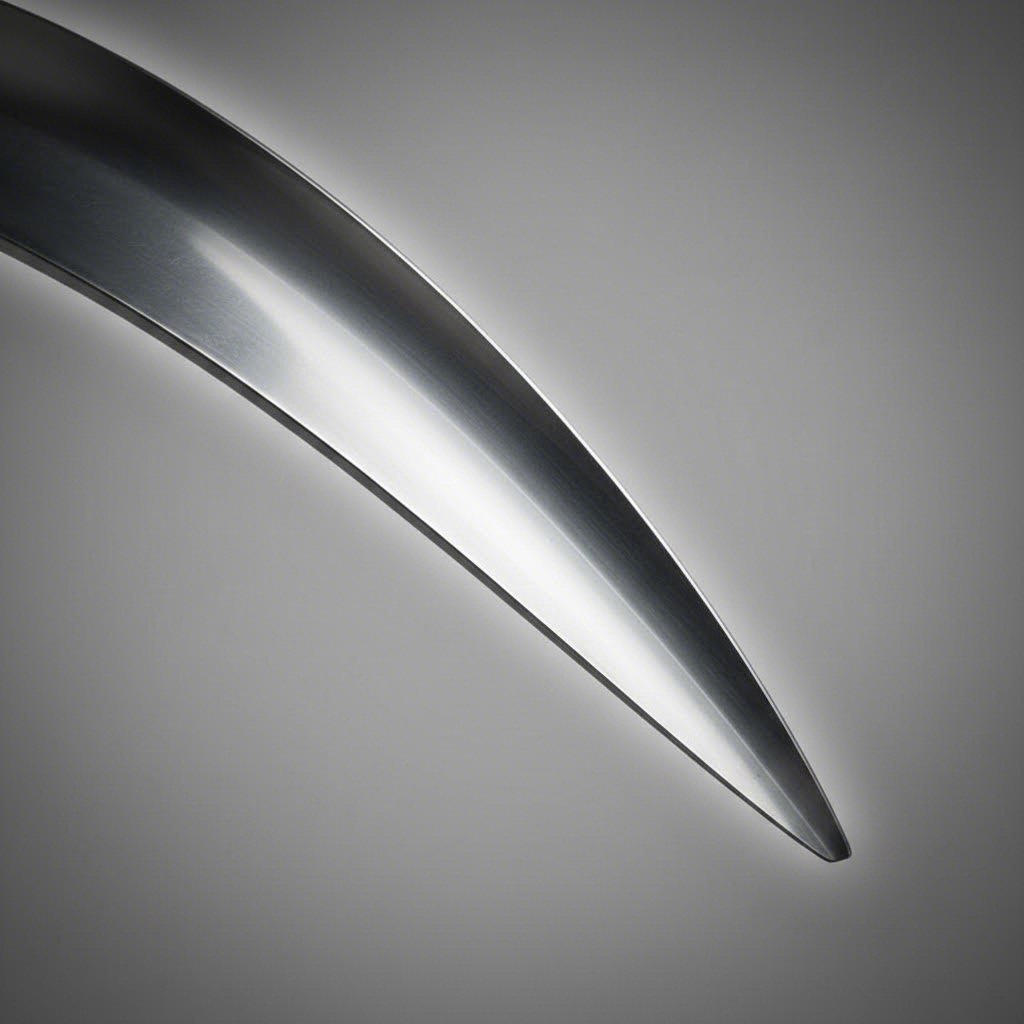
An aluminum airfoil extrusion is an aluminum profile whose cross-section replicates an aerodynamic wing shape, featuring a curved leading edge that smoothly transitions to a tapered trailing edge.
This geometry isn't just for looks. The shape directly affects how the profile manages airflow, controls solar shading, and handles wind load. You'll encounter several related terms in specifications and catalogs: "aerofoil extrusion" is simply the British English spelling, while "wing profile" and "blade profile" describe the same cross-sectional concept but tend to appear in different industry contexts. Aerospace engineers favor "wing profile," HVAC specialists often use "blade profile," and architectural specifiers typically stick with "airfoil." These terms map to regional and industry conventions rather than different products.
The airfoil shape borrows directly from aeronautical engineering. Imagine slicing through an airplane wing perpendicular to its span. You'll see a profile with specific geometric features that determine how air flows around it.
Three parameters define the cross-section:
Thickness varies along the chord. Most aluminum extrusion shapes used in architectural applications have their maximum thickness positioned roughly one-quarter to one-third back from the leading edge. This placement allows airflow to accelerate smoothly over the curved front surface before gradually decelerating toward the trailing edge.
So why go through the trouble of extruding this specific geometry when simpler rectangular or flat profiles exist? The answer comes down to performance across four dimensions.
First, airflow deflection. The curved leading edge and tapered trailing edge allow air to flow around the profile with minimal turbulence. In louver and ventilation applications, this means better airflow control with less noise and pressure drop compared to flat blades.
Second, reduced drag. When wind hits a flat surface, it creates significant pressure drag. The streamlined airfoil shape lets wind pass around the profile more efficiently, reducing the structural load on mounting systems. This matters especially in high-wind installations where flat blades would require heavier support structures.
Third, shading performance. The curved geometry creates predictable shadow patterns that architects can calculate precisely. Aluminum profile extrusion in airfoil shapes allows designers to optimize the balance between daylight admission and solar heat gain based on blade angle and spacing.
Fourth, aesthetic appeal. The sleek, aviation-inspired profile simply looks more refined than flat alternatives. For facade applications where the aluminum extrusion profiles remain visible, the airfoil shape adds visual sophistication while delivering functional benefits.
Understanding these fundamentals helps you specify the right profile for your application. The following sections dig into the geometry parameters, alloy choices, and manufacturing considerations that separate a well-specified airfoil extrusion from a generic one.
You've seen the basic shape. Now let's talk numbers. When specifying an aluminum extrusion profile for louvers or facade blades, two geometric parameters drive nearly every performance outcome: chord length and thickness-to-chord ratio. Understanding how these interact helps you balance shading, wind resistance, and visual appearance without over-engineering or under-specifying.
The chord is the straight-line distance from the leading edge to the trailing edge. In architectural applications, chord lengths typically range from 50 mm for compact louver blades up to 300 mm or more for large-scale facade screens. The chord sets the overall scale of the profile and directly influences how much shadow the blade casts.
Thickness-to-chord ratio expresses the profile's maximum height as a percentage of its chord length. A blade with a 200 mm chord and 24 mm maximum thickness has a 12% thickness-to-chord ratio. This ratio, rather than absolute thickness alone, determines how the profile behaves aerodynamically and visually.
Here's why this matters for extrusion aluminum applications:
Most architectural airfoil profiles place maximum thickness between 25% and 35% of the chord from the leading edge. This forward positioning mirrors aerospace practice, where it helps airflow accelerate smoothly over the front surface before gradually decelerating toward the trailing edge.
Imagine wind hitting a flat rectangular blade versus an airfoil blade. The flat blade creates a large pressure differential between its windward and leeward faces, generating significant drag force. The airfoil's curved leading edge, by contrast, allows approaching air to split and flow smoothly around both surfaces. This reduces pressure drag and lets the airflow reattach cleanly at the trailing edge.
Research on shading louvers and wind pressure shows that blade geometry significantly affects wind pressure coefficients on building facades. When louver rotation angles increase beyond 60 degrees, wind pressure coefficients drop substantially across all floors. The airfoil shape helps manage these pressure differentials more predictably than flat alternatives.
For shading performance, the thickness-to-chord ratio creates a direct trade-off. Thicker profiles cast deeper shadows but present more surface area to wind. Thinner profiles reduce wind load but may require tighter blade spacing to achieve equivalent shading. The table below summarizes these relationships:
| Thickness-to-Chord Ratio | Shading Effectiveness | Wind Resistance | Typical Application |
|---|---|---|---|
| Low (6-10%) | Lower shadow depth; requires closer spacing | Lower drag; lighter support structure | High-wind coastal installations, open screens |
| Medium (10-15%) | Balanced shadow depth and light transmission | Moderate drag; standard support structure | General architectural louvers, pergola blades |
| High (15-20%) | Deep shadows; effective solar control | Higher drag; heavier support structure | Sun shading on south-facing facades, canopies |
The curved leading edge does more than reduce drag. It also creates a predictable stagnation point where airflow velocity drops to zero before splitting around the profile. This predictability matters for ventilation applications where you need consistent airflow behavior across varying wind speeds and directions.
When you're building an aluminum extrusion frame for a louver system, these geometric choices cascade into structural requirements. A 4040 aluminum extrusion frame supporting high-thickness-ratio blades in a windy location needs more robust connections than a 2040 aluminum extrusion frame holding slim blades in a sheltered courtyard. The geometry you specify for the blades directly affects the support structure you'll need.
With the geometric principles clear, the next consideration is material selection. The alloy and temper you choose determine whether your airfoil profile can deliver the mechanical properties its geometry promises.
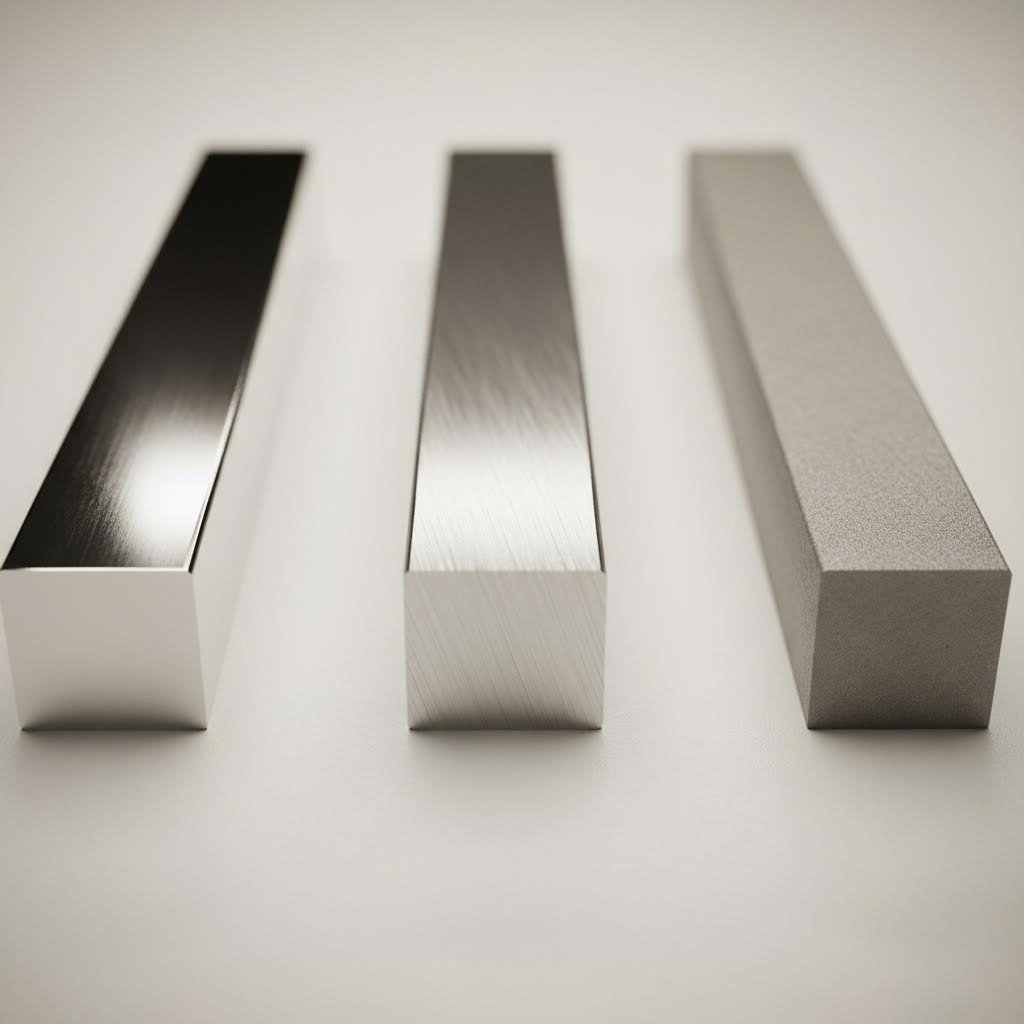
You've nailed down the geometry. But here's where many specifiers stumble: picking the wrong alloy or temper for the job. An airfoil profile with perfect aerodynamic proportions won't perform if the material can't handle the structural loads or deliver the surface finish your project demands. Let's break down the three aluminum extrusions most commonly used for airfoil profiles and explain when each one makes sense.
The 6000 series dominates the aluminum extrusion process for airfoil applications because these alloys balance strength, corrosion resistance, and workability. But within this family, three alloys stand out for different reasons.
6063 is the go-to choice for architectural applications. Why? It extrudes beautifully through complex die shapes, including the curved leading edges and tapered trailing edges that define airfoil geometry. The alloy's low iron and manganese content produces exceptionally clean surfaces after anodizing, making it ideal for anodized aluminum extrusions where appearance matters. If you're specifying louver blades for a visible facade where aesthetics drive the decision, 6063 delivers.
The trade-off? Lower mechanical strength compared to its siblings. For decorative applications or lightly loaded blades, this isn't a problem. But when your airfoil profile needs to span longer distances or handle significant wind loads, you'll want something stronger.
6061 flips the equation. This alloy offers higher tensile and yield strength, making it the standard for structural applications. Aircraft fittings, marine hardware, and load-bearing components typically specify 6061 because it combines strength with good corrosion resistance and weldability. For airfoil blades that must carry significant loads or span long distances without intermediate supports, 6061 provides the mechanical backbone.
The downside? It's harder to extrude through complex shapes, and the surface finish after anodizing won't match 6063's quality. If you're building a custom aluminum extrusion for a structural application where the profile will be painted or hidden, this matters less.
6005A sits between these two. It offers better strength than 6063 with better extrudability than 6061. You'll find it commonly specified in transport applications (rail car components, truck bodies) and structural facade systems where both strength and reasonable surface quality matter. For airfoil profiles that need to balance structural performance with decent aesthetics, 6005A often hits the sweet spot.
The table below compares these alloys across the dimensions that matter for airfoil specification:
| Alloy | Tensile Strength (T6) | Yield Strength (T6) | Extrudability | Surface Finish Suitability | Typical Application |
|---|---|---|---|---|---|
| 6063 | ~240 MPa (35 ksi) | ~215 MPa (31 ksi) | Excellent | Excellent for anodizing | Architectural louvers, window frames, decorative blades |
| 6061 | 310 MPa (45 ksi) | 276 MPa (40 ksi) | Good | Good; better suited for painting | Structural blades, load-bearing profiles, marine applications |
| 6005A | ~270 MPa (39 ksi) | ~225 MPa (33 ksi) | Very Good | Good | Transport, structural facades, rail profiles |
If you follow aluminum extrusion news, you'll notice growing interest in 6005A for facade applications precisely because it bridges the gap between architectural finish quality and structural performance.
Alloy selection is only half the equation. The temper designation tells you how the aluminum was heat-treated after extrusion, and this directly affects mechanical properties and dimensional stability.
T5 temper uses air quenching immediately after extrusion, by artificial aging. The gentler cooling minimizes distortion, making T5 ideal for profiles where tight geometric tolerances matter more than maximum strength. For decorative airfoil blades that won't carry significant loads, T5 delivers good dimensional control at lower cost.
T6 temper starts with a water quench that rapidly cools the profile, locking in a supersaturated state. Artificial aging follows to develop the alloy's full strength. The result? Significantly higher tensile and yield strength compared to T5. When your airfoil profile must handle structural loads or span longer distances, T6 provides the mechanical performance you need.
T66 temper adds a mechanical stretching step after water quenching but before aging. This relieves internal stresses and corrects any distortion from the rapid quench. You get strength comparable to T6 with improved dimensional accuracy. For demanding structural applications in automotive or rail industries, T66 guarantees minimum mechanical properties that T6 doesn't always deliver.
Here's how to think about the choice:
The combination of alloy and temper creates a matrix of options. A 6063-T5 profile works perfectly for a decorative pergola blade, while a 6061-T6 profile suits a structural facade screen exposed to high wind loads. Getting this combination right ensures your airfoil extrusion delivers the performance its geometry promises.
Once you've selected the alloy and temper, the next question is how the profile actually gets made. The aluminum extrusion process for airfoil shapes presents unique challenges that affect both cost and quality.
Ever wonder why some custom aluminum extrusions cost more than others with similar dimensions? The answer often lies in the cross-section geometry. Airfoil profiles present manufacturing challenges that standard rectangular or T-slot shapes simply don't. The asymmetric curve of the leading edge, the gradual taper toward the trailing edge, and the hollow or semi-hollow interior all demand precise control at every stage of production.
Here's the sequence that transforms a solid aluminum billet into a finished airfoil profile:
Each stage affects the next. Get the billet temperature wrong, and you'll fight surface defects downstream. Use an undersized aluminum extrusion press, and you won't achieve the dimensional accuracy the profile demands. Let's walk through the critical steps.
The aluminum extrusion die is where geometry becomes reality. For airfoil shapes, die design gets complicated fast. Unlike symmetric profiles where metal flows evenly through the die opening, an airfoil's asymmetric cross-section creates uneven flow paths. The thick leading-edge region wants more material than the thin trailing edge. Without careful compensation, you'll end up with dimensional variation, surface defects, or both.
Die designers address this through several techniques:
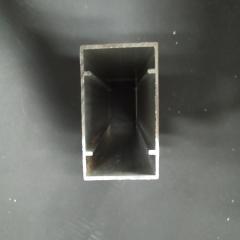
For hollow airfoil profiles, the tooling complexity increases further. A porthole or bridge die uses mandrels and support legs to create internal cavities. The aluminum splits around these supports, flows through a welding chamber, and rejoins before exiting as a continuous hollow section. The mandrel defines the internal void while bridges maintain structural integrity under thousands of tons of pressure.
Why does this matter for specifiers? Die complexity directly affects cost and lead time. A new airfoil die typically costs more than a standard structural die and takes longer to manufacture. If you're ordering custom aluminum extrusions with an airfoil cross-section, expect die development to add several weeks to your timeline. However, once the die exists, subsequent orders use the same tooling, so the upfront investment pays off over production volume.
The aluminum extrusion machine must deliver enough force to push heated aluminum through the die at a controlled rate. Press tonnage requirements depend on the profile's circumscribing circle diameter (CCD), wall thickness, and alloy. Larger airfoil profiles with thin walls and high-strength alloys like 6061 demand more press capacity than compact 6063 blades.
Billet temperature plays a critical role. For 6000 series alloys commonly used in airfoil profiles, billets are heated to approximately 415-455°C depending on the specific alloy. The container temperature should run 10-38°C lower than the billet to prevent thermal defects. When temperatures drift outside these windows, scrap rates climb, and aluminum extrusion scrap price becomes a real concern for manufacturers trying to maintain margins.
What happens after the profile exits the die determines its final properties. Quenching locks in the alloy's heat-treated state by rapidly cooling the profile. The cooling method matters:
For hollow airfoil profiles, uneven cooling creates particular challenges. The internal cavity cools differently than the outer surfaces, potentially causing bowing or twist. Experienced extruders adjust quench nozzle positions and flow rates to achieve uniform cooling across the asymmetric cross-section.
After cooling, stretching straightens the profile and relieves internal stresses. This step is especially important for long airfoil blades where even slight bow becomes visible. Finally, artificial aging at 170-185°C for 6-8 hours develops the alloy's full mechanical properties before aluminum extrusion machining or surface treatment.
The interplay between die quality, press capacity, and thermal control determines whether your airfoil profile meets specification. A well-equipped extruder with experience in complex geometries can hold tighter tolerances and deliver better surface finish than one pushing equipment limits. When evaluating suppliers, ask about their press range, die design capabilities, and quality control procedures for asymmetric profiles.
With the manufacturing process understood, the next logical question is how aluminum airfoil extrusions compare against alternative materials for the same applications.
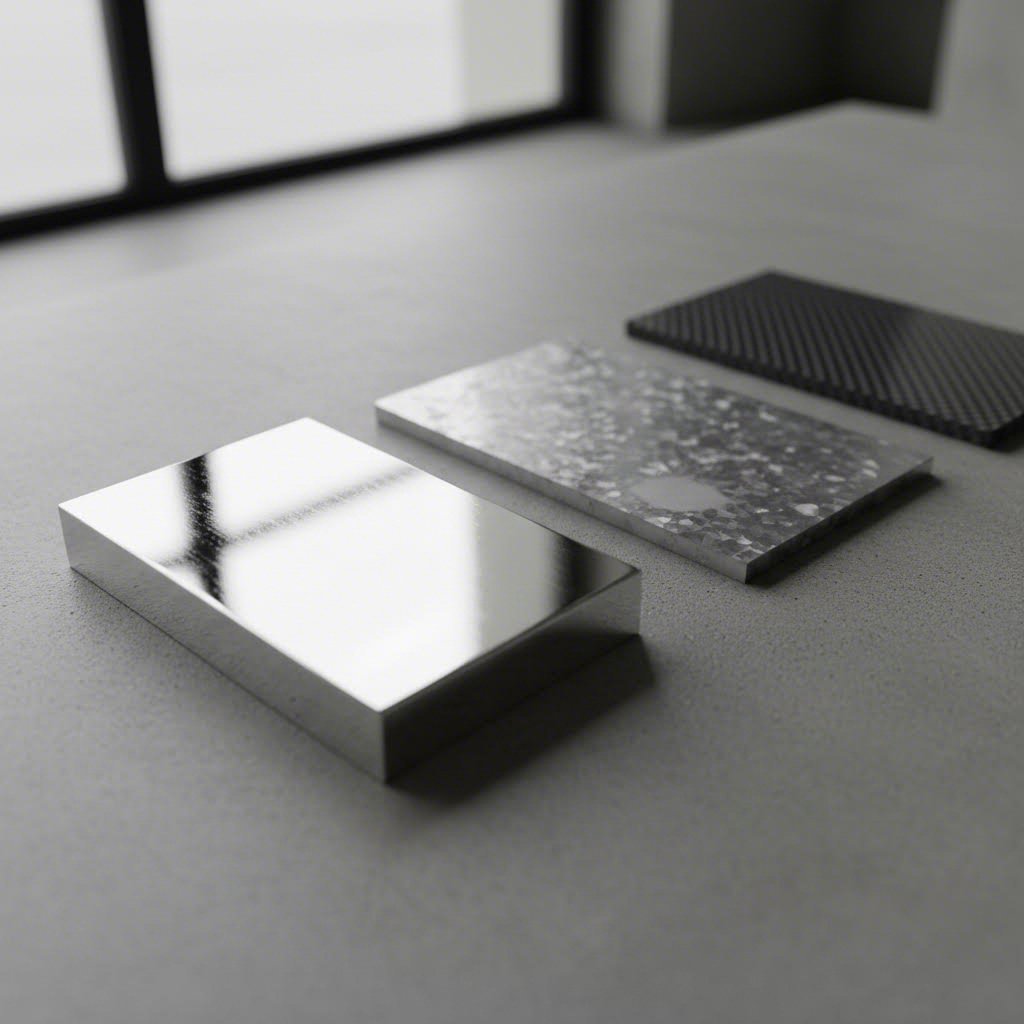
So you've got the geometry dialed in and the alloy selected. But here's a question that comes up in nearly every specification meeting: why aluminum at all? Steel is stronger. Fiberglass doesn't corrode. PVC costs less. Each material has its advocates, and each has legitimate applications. The trick is understanding where aluminum airfoil profiles genuinely outperform the alternatives and where another material might actually make more sense for your project.
Steel and aluminum compete head-to-head in louver and facade applications, but they play to very different strengths. Steel wins on raw tensile strength. Aluminum wins on almost everything else that matters for airfoil blades.
Start with weight. Aluminum weighs roughly one-third as much as steel for equivalent volume. For airfoil blades mounted on a facade or spanning between supports, this weight difference cascades through the entire structural system. Lighter blades mean lighter brackets, smaller fasteners, and reduced load on the primary structure. When you're specifying standard aluminum extrusions for a large louver array, the cumulative weight savings can significantly reduce installation complexity and cost.
Corrosion resistance is where aluminum really pulls ahead. Aluminum's natural oxide layer provides inherent protection against rust without any coating. Steel, by contrast, requires galvanizing, painting, or powder coating to prevent corrosion, and those protective layers need maintenance over time. In coastal environments or humid climates, unprotected steel will rust. Even galvanized steel eventually shows corrosion at cut edges or scratches. Aluminum channel extrusions and airfoil profiles simply don't have this problem.
Formability creates another clear advantage. The extrusion process allows aluminum to take on complex airfoil cross-sections with curved leading edges and tapered trailing edges in a single operation. Steel airfoil shapes typically require roll-forming or press-braking, which limits geometric complexity and often produces visible seams. If your design calls for a true aerodynamic profile with smooth surfaces, aluminum extrusion delivers what steel fabrication cannot.
The trade-off? Steel costs less per pound and offers higher absolute strength. For applications where weight doesn't matter and the profile will be hidden or painted anyway, steel can make economic sense. But for visible architectural applications where corrosion resistance, surface finish, and weight all matter, aluminum typically wins the lifecycle cost analysis.
Fiberglass and PVC enter the conversation when corrosion resistance is paramount or budget constraints are tight. Both have legitimate applications, but neither matches aluminum's overall performance profile for airfoil blades.
Fiberglass offers excellent corrosion resistance, comparable to aluminum. It won't rust, rot, or degrade in humid environments. For chemical processing facilities or marine applications where aggressive environments attack metals, fiberglass can be a smart choice. However, fiberglass has significant drawbacks for airfoil applications. Dimensional precision is harder to achieve than with aluminum extrusion. The material is difficult to recycle, often ending up in landfills at end of life. And fiberglass profiles typically require more complex tooling and longer production runs to be cost-effective.
PVC profiles offer the lowest upfront cost and excellent thermal insulation properties. For window frames and interior applications, PVC makes sense. But for exterior airfoil blades, PVC falls short on several fronts. Structural performance degrades at elevated temperatures, limiting span capability in hot climates. UV exposure causes gradual degradation without proper stabilizers. And while PVC is technically recyclable, the process is more complex than aluminum recycling, and much PVC ends up in landfills.
The aluminum extrusion market continues to grow precisely because the material balances so many competing requirements. Lifecycle cost analyses consistently show that aluminum's higher initial cost is offset by lower maintenance, longer lifespan, and full recyclability. Aluminum panels and profiles can last 40+ years with minimal attention, while competing materials often require more frequent replacement or maintenance.
The table below summarizes how these materials compare across the dimensions that matter most for airfoil blade applications:
| Material | Weight (Relative) | Corrosion Resistance | Span Capability | Recyclability | Relative Cost |
|---|---|---|---|---|---|
| Aluminum | Low | High (inherent oxide layer) | High | High (100% recyclable indefinitely) | Medium-High |
| Steel | High | Low (requires protective coating) | Very High | High (recyclable but energy-intensive) | Medium |
| Fiberglass | Medium | High | Medium | Low (difficult to recycle) | Medium-High |
| PVC | Low | High | Low (degrades at elevated temperatures) | Low-Medium | Low |
For most architectural airfoil applications, aluminum hits the sweet spot. It's light enough to simplify installation, strong enough to span reasonable distances, corrosion-resistant without coatings, and fully recyclable at end of life. The available range of aluminum extrusion sizes means you can find or create profiles that match your exact geometric and structural requirements.
Material selection sets the foundation. But knowing where these profiles actually get used helps you understand which geometry, alloy, and finish combinations make sense for specific applications.
You've got the geometry, alloy, and manufacturing process down. Now the practical question: where do these profiles actually show up? Aluminum airfoil extrusions appear across a surprisingly wide range of applications, from the sun shading systems on commercial buildings to the inlet grilles on industrial HVAC equipment. Each application demands specific combinations of profile geometry, alloy selection, and surface treatment. Understanding these use cases helps you specify the right profile for your project rather than defaulting to a generic solution.
Here's a quick overview of the primary application categories:
Let's dig into what each application requires and why.
Sun control devices represent the largest market for aluminum profiles extrusion in airfoil shapes. Walk past any modern commercial building with horizontal or vertical blades projecting from the facade, and you're likely looking at airfoil extrusions doing their job.
Fixed louver systems use stationary blades mounted at a predetermined angle. These are the simpler case from a structural standpoint. The blades attach to tube or plate outriggers using mechanical fasteners, and the entire assembly remains static throughout its service life. For fixed installations, 6063-T5 aluminum extrusion parts typically deliver the right balance of surface finish quality and adequate strength. The profile geometry depends on the shading requirement: south-facing facades in hot climates often specify high thickness-to-chord ratios (15-20%) for maximum shadow depth, while east and west orientations may use slimmer profiles to manage low-angle morning and afternoon sun.
Adjustable louver systems add complexity. When blades rotate to track sun angle or respond to occupant preferences, the structural requirements change significantly. Each blade pivots on an aluminum extrusion rail or rod running through its length, and the pivot point becomes a stress concentration. Motorized systems demand tighter tolerances at the pivot zone and higher yield strength to handle repeated cycling without deformation. For adjustable applications, specifiers often step up to 6063-T6 or even 6005A-T6 to ensure the pivot area maintains dimensional stability over thousands of rotation cycles.
The construction approach matters too. Most quality sun shading systems use mechanically fastened aluminum extrusions rather than welded assemblies. This method enhances strength and integrity while allowing easy replacement of individual components post-installation. If a single blade gets damaged, you can swap it out without dismantling the entire system.
Ventilated facades use airfoil blades as the outer skin of a rainscreen system. The concept is straightforward: an air chamber separates the cladding from the building's primary structure, creating continuous ventilation that improves thermal performance.
During summer, the chimney effect draws hot air upward through the cavity, reducing heat transfer to the interior and cutting air conditioning loads by approximately 30%. In winter, the air chamber acts as a buffer that minimizes heat loss. The airfoil blade shape contributes to this performance by allowing controlled airflow while providing visual screening and weather protection.
For ventilated facade applications, profile selection balances aesthetics with durability. The blades remain visible and exposed to weather, so surface finish quality matters. Most projects specify 6063 alloy for its excellent anodizing characteristics. Chord lengths typically range from 100-200 mm, with medium thickness-to-chord ratios (10-15%) that balance shading effectiveness against wind load. The aluminum extrusion enclosure created by the blade array must handle thermal cycling, UV exposure, and wind-driven rain without degradation over a 40+ year service life.
Pergolas and canopies use airfoil blades to create sheltered outdoor spaces. Unlike facade-mounted louvers, these applications often span longer distances between supports, which changes the structural calculus.
Imagine a pergola covering an outdoor dining area. The blades might span 3-4 meters between support beams, and they need to handle not just their own weight but also wind uplift, rain loads, and potentially snow accumulation. For these longer spans, specifiers typically move to 6061-T6 or 6005A-T6 alloys that deliver higher yield strength. Profile geometry shifts toward higher thickness-to-chord ratios that increase the blade's moment of inertia and reduce deflection under load.
Canopy systems add another consideration: the blades often cantilever from a single support rather than spanning between two points. This cantilever configuration concentrates stress at the attachment point, requiring robust aluminum extrusion slider mechanisms or fixed brackets designed to handle the bending moment. The profile's wall thickness at the attachment zone becomes critical, and some designs incorporate reinforced sections or internal stiffeners to distribute load.
Beyond architecture, airfoil extrusions serve functional roles in HVAC systems, marine equipment, and aerospace structures.
HVAC inlet and outlet grilles use airfoil blades to direct airflow while minimizing pressure drop and noise. The aerodynamic profile allows air to flow smoothly around each blade rather than creating turbulence at sharp edges. For these applications, the aluminum extrusion case typically involves compact profiles with chord lengths under 100 mm and low thickness-to-chord ratios (6-10%) that maximize open area while maintaining structural integrity. Alloy selection depends on the environment: 6063 works for standard indoor applications, while 6061 or marine-grade alloys suit corrosive industrial settings.
Marine applications demand corrosion resistance above all else. Airfoil profiles appear in boat ventilation systems, deck hardware, and structural components where the aerodynamic shape reduces drag or manages airflow. These applications typically specify 6061-T6 for its combination of strength and corrosion resistance, often with additional anodizing or coating for saltwater exposure.
Aerospace structural components represent the most demanding application category. Here, the airfoil shape serves its original aerodynamic purpose, and material specifications become extremely tight. While architectural applications tolerate reasonable dimensional variation, aerospace components require precision that pushes extrusion technology to its limits. These applications fall outside typical architectural specification but illustrate the performance ceiling that aluminum airfoil extrusions can achieve.
Understanding these application categories helps you match profile specifications to project requirements. A decorative pergola blade doesn't need aerospace-grade tolerances, and an HVAC grille doesn't need the surface finish quality of a visible facade element. The next consideration is how surface treatments protect and enhance these profiles for their intended service environment.
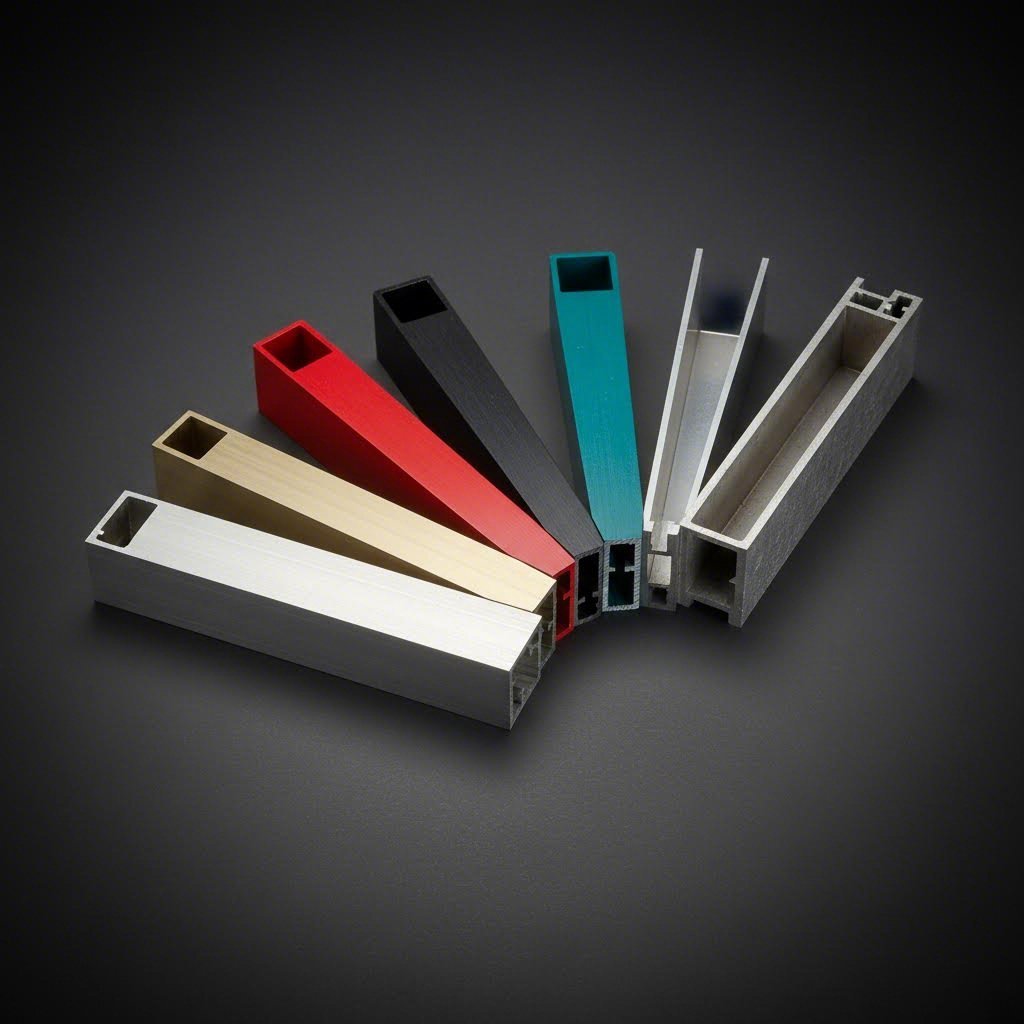
You've selected the alloy, specified the geometry, and understood the manufacturing process. But here's a detail that can make or break your project: the surface treatment. A raw aluminum airfoil profile won't last long in an outdoor environment. The finish you choose determines corrosion resistance, appearance, maintenance requirements, and even dimensional fit with aluminum extrusion connectors and mounting hardware.
Surface treatment isn't just about color. Each finishing method creates a fundamentally different protective layer with distinct performance characteristics. The right choice depends on your exposure conditions, aesthetic requirements, and budget. Let's walk through the options that matter for airfoil profiles.
Anodizing remains the preferred finish for architectural airfoil blades exposed to weather. Why? Because the process doesn't add a coating on top of the aluminum. Instead, it transforms the surface itself into a hard, corrosion-resistant aluminum oxide layer that's integral to the metal.
The electrochemical process works by immersing the aluminum in a sulfuric acid bath and applying direct current. Oxygen atoms combine with aluminum atoms at the surface, growing an oxide layer that's significantly harder and more durable than the natural oxide film that forms on untreated aluminum.
Two types dominate architectural applications:
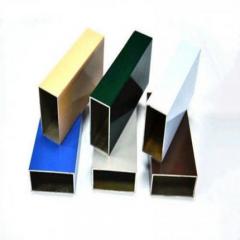
Type II anodizing (sulfuric acid anodizing) creates a moderate oxide layer that provides excellent corrosion resistance and accepts dyes for color. This is the standard choice for architectural facades, window frames, and decorative blades where appearance matters. The anodized surface maintains its color and appearance over time, unlike painted surfaces that can fade or peel.
Type III anodizing (hardcoat) uses lower temperatures and higher voltages to produce a significantly thicker, denser oxide layer. The result is exceptional hardness and wear resistance, making it suitable for components subjected to harsh mechanical conditions. For airfoil blades in high-traffic areas or industrial environments where abrasion is a concern, Type III delivers superior durability.
Here's where alloy selection intersects with finish choice. Remember 6063 from the alloy discussion? Its low iron and manganese content produces exceptionally clean surfaces after anodizing. If you're specifying black aluminum extrusion for a visible facade, 6063 with Type II anodizing delivers the most uniform, attractive appearance. Higher-strength alloys like 6061 can be anodized, but the surface quality won't match 6063's refinement.
Anodizing isn't always the answer. When you need specific colors, textures, or enhanced protection for extreme environments, other finishes enter the picture.
Powder coating applies dry powder electrostatically, then cures it with heat to form a durable finish. The process offers tremendous design flexibility: virtually any color, multiple textures, and decorative effects that anodizing can't achieve. For aluminum extrusion accessories like brackets and trim pieces where color matching matters, powder coating delivers.
The trade-off? Powder coating adds layer thickness, typically 60-80 microns. For tight-tolerance assemblies where airfoil blades must fit precisely into mounting channels, you'll need to account for this buildup. The coating also sits on top of the aluminum rather than integrating with it, so adhesion depends on proper surface preparation. In demanding outdoor environments, powder-coated surfaces may require periodic inspection and maintenance.
PVDF (polyvinylidene fluoride) coatings step up the performance for harsh exposures. This fluoropolymer creates a barrier that safeguards against UV radiation, moisture, chemicals, and pollution. PVDF-coated aluminum maintains color stability over decades in extreme outdoor conditions, making it the standard for high-end architectural facades, curtain walls, and coastal installations where salt spray attacks other finishes.
The initial cost runs higher than powder coating, but lifecycle economics often favor PVDF. Lower maintenance, reduced repainting cycles, and extended service life offset the upfront premium. For projects where long-term appearance matters, PVDF delivers.
Micro-arc oxidation (MAO), also called plasma electrolytic oxidation (PEO), represents the cutting edge of surface treatment. This electrochemical process uses high-voltage plasma discharges to create an extremely hard ceramic-like layer on the aluminum surface. The coating bonds metallurgically to the base metal, providing exceptional wear resistance, corrosion protection, and thermal stability.
MAO coatings make the surface almost ceramic-hard, reducing scratches and wear significantly. The layer blocks water, salt, and chemicals from reaching the metal, and it stays stable at high temperatures. For airfoil profiles in industrial equipment, high-wear applications, or environments with thermal cycling, MAO offers protection that conventional anodizing can't match.
Here's a comparison of the main finish options:
When you're building an aluminum extrusion desk or workstation frame for indoor use, powder coating in a custom color makes sense. For a coastal facade exposed to salt spray and intense UV, PVDF justifies its premium. For industrial louvers in a chemical plant, MAO might be the only finish that survives.
Finding a supplier who offers the full range of surface treatments simplifies specification and quality control. Shengxin Aluminium, for example, provides anodizing in custom colors (including champagne and rose gold), powder coating, PVDF, and micro-arc oxidation under one roof. This end-to-end capability means your airfoil profiles move from extrusion through finishing without changing hands, reducing lead time and ensuring consistent quality across the production run.
Surface treatment completes the specification picture for the profile itself. But before you place an order, you'll want to understand the quality standards that govern aluminum extrusions and how to evaluate whether a supplier can actually deliver what they promise.
You've specified the alloy, geometry, and surface finish. But here's where many procurement teams stumble: how do you know the profiles you receive actually match what you ordered? A 6063-T6 airfoil blade looks identical to a 6063-T5 blade. The difference only shows up in mechanical testing or when the profile fails under load. Understanding quality standards and knowing what documentation to request separates successful projects from expensive surprises.
Three standards govern most aluminum airfoil extrusion specifications worldwide. Which one applies depends on your project location and industry requirements.
EN 755 is the European standard series covering aluminum alloy extruded rod, bar, tube, and profiles. It specifies dimensional tolerances, mechanical properties, and surface quality requirements. If you're working on a project in Europe or specifying to European standards, EN 755 defines what "acceptable" means for cross-sectional dimensions, straightness, twist, and surface finish. The standard breaks into multiple parts: EN 755-1 covers general conditions, EN 755-2 addresses mechanical properties, and EN 755-9 specifies tolerances for profiles.
ASTM B221 serves the same function for North American projects. This US standard covers aluminum and aluminum-alloy extruded bars, rods, wire, profiles, and tubes. It defines chemical composition limits, mechanical property requirements, and dimensional tolerances. When you're sourcing from aluminum extrusion manufacturers for a US project, ASTM B221 is typically the governing specification.
The Aluminum Association (AA) publishes dimensional tolerance standards that many aluminum extrusion companies reference regardless of geographic location. These tolerances define acceptable variation in wall thickness, angles, contours, and straightness based on profile size and complexity. For airfoil profiles with their curved leading edges and tapered trailing edges, AA tolerances help establish realistic expectations for dimensional accuracy.
Why does this matter? When you specify "6063-T6 per ASTM B221," you're invoking a complete set of requirements that any qualified manufacturer of aluminum extrusions should understand and meet. Without a standard reference, "acceptable quality" becomes subjective, and disputes become inevitable.
Standards define requirements. Documentation proves compliance. Here's what to request before accepting any shipment of airfoil profiles.
Mill test certificates (MTCs) confirm that the aluminum matches your specification. Every MTC should include the heat number (a unique identifier linking the material to a specific melt batch), chemical composition analysis showing percentages of aluminum, silicon, magnesium, iron, copper, zinc, and manganese, and mechanical property test results including tensile strength, yield strength, and elongation. The heat number enables full traceability; if problems emerge later, you can trace affected profiles back to their source batch.
When reviewing an MTC, check that chemical composition values fall within the standard limits for your specified alloy. Small variations in chemistry affect corrosion resistance, surface finish quality, and formability. Also verify that mechanical properties match the temper designation. A 6061-T6 profile should show tensile strength around 310 MPa and yield strength around 276 MPa. If the numbers don't align with published alloy data, something's wrong.
Dimensional inspection reports document that the profiles meet geometric tolerances. For airfoil extrusions, critical dimensions include chord length, maximum thickness, wall thickness at various points along the profile, and overall straightness. The report should reference the specific drawing revision and tolerance standard used for evaluation. Common measurement tools include vernier calipers and micrometers for basic dimensions, coordinate measuring machines (CMM) for complex cross-sections, and straight edges with feeler gauges for straightness checks.
Surface treatment test reports verify coating quality. For anodized profiles, request thickness measurements per ISO 7599 or equivalent, typically using the eddy current method. For powder-coated profiles, adhesion test results (cross-hatch method) and coating thickness measurements confirm proper application. Salt spray test results per ASTM B117 demonstrate corrosion resistance for coated profiles intended for harsh environments.
A smooth procurement process starts with clear communication. Before requesting quotes from aluminum extrusion suppliers, prepare the following information:
When evaluating quotes, look beyond unit price. Check die ownership terms: who owns the die after production, and what happens if you need to move production to another aluminum extrusion company? Understand minimum order quantities for both initial orders and reorders. Compare lead times for new die development versus production using an existing die. A supplier quoting 2-3 weeks for a new die is either cutting corners or has exceptional die shop capabilities; typical new die lead times run 4-6 weeks for complex airfoil profiles.
Ask about the supplier's quality management system. ISO 9001 certification indicates a documented quality system, but dig deeper. What inspection equipment do they use? Do they have spectrometers for alloy verification, CMMs for dimensional inspection, and hardness testers for mechanical property spot-checks? Can they provide First Article Inspection (FAI) reports before full production begins?
Red flags during supplier evaluation include reluctance to share quality documentation, vague answers about inspection procedures, and operators who can't describe QC processes clearly. A professional aluminum extrusion services provider welcomes questions about quality because they've invested in the systems to answer them.
When profiles arrive, don't just count boxes. Perform incoming inspection to catch problems before they become expensive.
Start with visual inspection under adequate lighting. Check for surface scratches, dents, die lines, and coating defects. For anodized profiles, look for color uniformity and absence of streaks. For powder-coated profiles, check for orange peel texture, runs, or thin spots.
Perform dimensional spot-checks on a sample basis. Measure chord length, maximum thickness, and wall thickness at multiple points along several profiles. Compare results against the drawing tolerances. Check straightness by placing profiles on a flat surface and looking for gaps or twist.
Review all accompanying documentation. Verify that the MTC heat number matches the marking on the profiles. Confirm that chemical composition and mechanical properties fall within specification limits. Check that surface treatment test reports show acceptable results.
If anything doesn't match, document the discrepancy immediately and contact the supplier before using the material. Catching problems at incoming inspection costs far less than discovering them during installation or, worse, after the project is complete.
Quality standards and supplier evaluation establish the foundation for successful procurement. But even perfect profiles can fail if structural and installation considerations aren't addressed during specification.
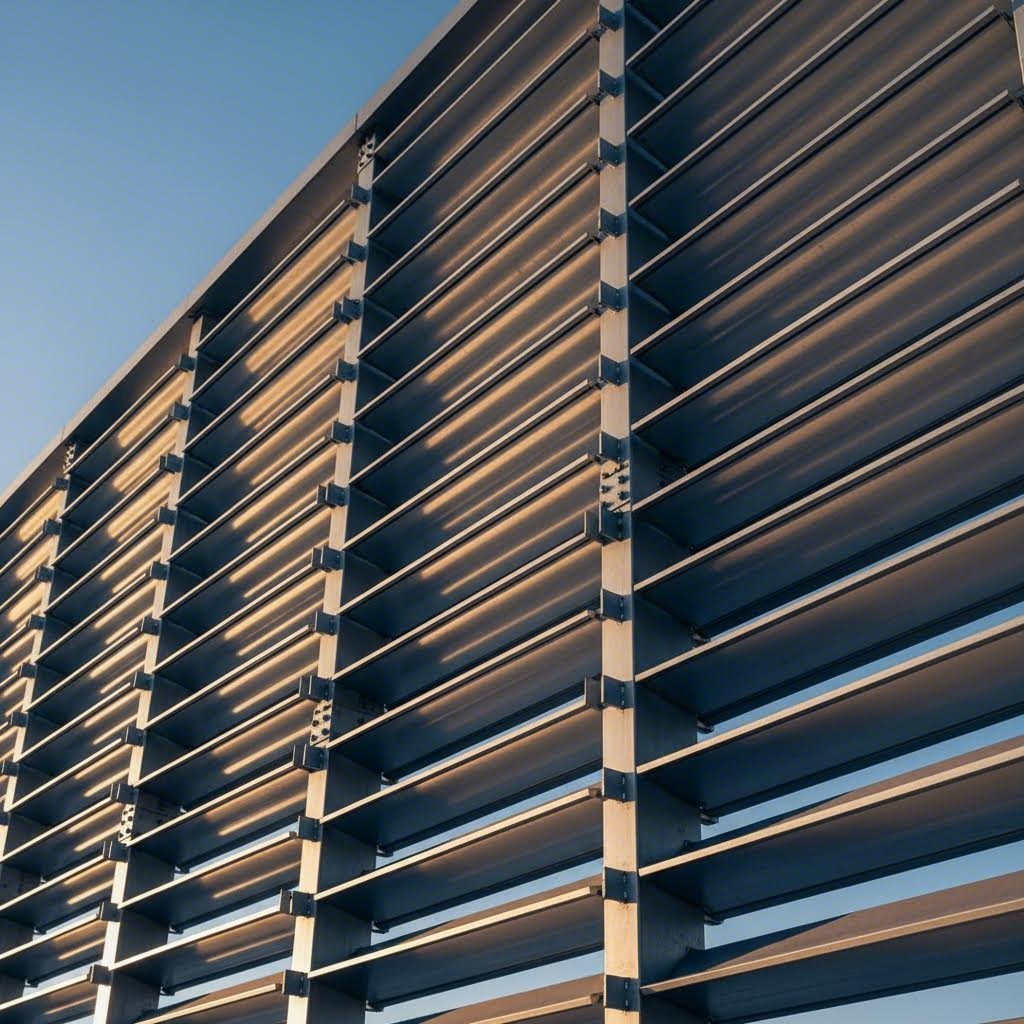
You've selected the perfect alloy, specified the geometry, verified the supplier's credentials, and chosen the right surface treatment. But here's where projects go sideways: the profiles arrive on site, and nobody has properly calculated whether they'll actually work structurally. An airfoil blade that looks great in a catalog can fail spectacularly if span length, fixing intervals, and wind loads weren't properly addressed during specification.
This section covers what architects and engineers need to understand before finalizing their designs. The principles aren't complicated, but they're frequently overlooked.
When wind hits an airfoil blade, it doesn't just push against the surface. The aerodynamic shape creates both drag and lift forces depending on the blade's angle relative to the wind direction. A blade tilted at 45 degrees experiences significant lift that tries to rotate it around its mounting points. Your aluminum extrusion brackets must handle both force components simultaneously.
Wind pressure calculations for louver systems typically follow ASCE 7 or equivalent regional codes. Top floors, podium corners, and mechanical levels attract the highest wind loads. Pressure coefficients vary significantly between open and enclosed louver configurations. For high-rise projects, wind tunnel testing on scaled models often reveals pressures exceeding 4.0 kPa at podium levels and up to -7.5 kPa for main tower areas.
Three geometric properties of your airfoil profile determine its structural behavior under load:
These properties interact with span length and fixing interval to determine whether your profile meets deflection requirements. Maximum deflection limits for louver blades typically range from L/180 to L/240, where L is the span between supports. Excessive movement causes rattle, fatigue at connection points, and potential anchorage failure over time.
Imagine a 200 mm chord airfoil blade spanning 2 meters between aluminum extrusion tube supports. The same profile spanning 3 meters experiences significantly higher bending stress and deflection. At some point, you either need a stiffer profile, closer fixing intervals, or a higher-strength alloy and temper combination.
The alloy and temper you specified earlier now become critical. A 6063-T5 blade might work perfectly at 1.5-meter spans but fail deflection limits at 2 meters. Stepping up to 6061-T6 increases yield strength by roughly 30%, allowing longer spans with the same profile geometry. Alternatively, you can maintain the alloy but reduce fixing intervals, adding more aluminum extrusion brackets to distribute the load.
For aluminum extrusion frame kits supporting louver arrays, the frame members themselves need verification. Reinforced mullions become necessary for spans above 2 meters. Large louver screens require both vertical and horizontal stiffeners to prevent racking under wind load. The load path must be continuous from blade to bracket to anchor to primary structure.
Consult a structural engineer for project-specific calculations. Generic span tables cannot account for site-specific wind exposure, blade angle, and safety factor requirements.
Here's a detail that catches many specifiers off guard: aluminum moves. A lot. When temperature changes, the metal expands or contracts proportionally. Aluminum's coefficient of thermal expansion runs approximately 23 µm/m·°C (or 0.0000128 per °F in imperial units). That's nearly twice the expansion rate of steel.
What does this mean in practice? A 3-meter aluminum blade experiencing a 50°C temperature swing (common between winter nights and summer afternoons) changes length by about 3.5 mm. That might not sound like much, but if both ends are rigidly fixed, the blade has nowhere to go. The result? Buckling, warping, or stress concentration at the fixing points that leads to fatigue failure over time.
The highest temperature a blade experiences isn't the air temperature. Solar absorption pushes surface temperatures well above ambient, especially on dark-colored finishes. A black anodized blade facing south can reach temperatures 30-40°C above the surrounding air on a sunny day.
Long blade runs require accommodation for this movement. Two common approaches work:
The fixed point (where the blade doesn't move relative to its support) should be located strategically, typically near one end. The opposite end then experiences the maximum thermal movement and needs slotted connections or sliding clips to accommodate it.
Motorized louver systems add another layer of complexity. When blades rotate to track sun angle or respond to building automation signals, the pivot point becomes a stress concentration. Every rotation cycle applies load to the pivot zone. Over thousands of cycles across years of operation, even small dimensional variations or material weaknesses can lead to failure.
For motorized applications, specifiers typically require:
An aluminum extrusion 2040 or similar modular framing profile might work fine for a fixed louver support structure. But motorized systems often require custom aluminum t extrusion designs with integrated pivot features and reinforced connection zones. The additional engineering and tooling cost pays off in long-term reliability.
Aluminum extrusion trim pieces around the perimeter of a louver array also need thermal expansion consideration. A continuous trim run along a 10-meter facade will grow and shrink by nearly 12 mm across typical temperature extremes. Without accommodation, the trim will buckle, gap, or stress its fasteners to failure.
The structural and installation principles covered here aren't optional extras. They're fundamental to whether your airfoil profiles perform as intended over their service life. With these considerations addressed, you're ready to pull together a complete specification and find the right supplier to execute it.
You've worked through the technical details. Now it's time to put everything together into a practical workflow you can use when approaching an aluminum extrusion supplier. Whether you're sourcing profiles for a single project or establishing a long-term supply relationship, having a clear specification checklist prevents miscommunication and ensures you get exactly what your application demands.
Before you start searching for where to buy aluminum extrusion profiles, organize your requirements into a complete specification package. Missing even one detail can delay quotes, extend lead times, or result in profiles that don't fit your application. Here's what every inquiry should include:
When reviewing quotes, don't focus solely on unit price. Clarify die ownership terms, minimum order quantities for reorders, and lead times for new die development versus production from existing tooling. A supplier offering aluminum extrusions for sale at the lowest price may not deliver the quality documentation or dimensional consistency your project requires.
The best aluminum extrusion manufacturer for your project isn't necessarily the largest or the cheapest. Look for a partner who covers the complete decision chain discussed throughout this article: die development capability, sufficient press capacity for your profile size, in-house surface treatment options, and documented quality systems.
If you're evaluating suppliers, look for a partner who covers these capabilities end-to-end. Shengxin Aluminium illustrates what a full-service aluminum extrusion supplier looks like in practice. With 35 extrusion presses ranging from 600T to 5500T, they handle everything from compact louver blades to large structural profiles. Their CNC machining centers provide precise cutting, drilling, and bending to meet tight tolerances. Surface treatment options include anodizing in custom colors, powder coating, PVDF, and micro-arc oxidation, all under one roof. This integrated approach means your airfoil profiles move from die development through finishing without changing hands, reducing lead time and quality variation.
When you find a potential aluminum extrusion manufacturer, request samples or visit their facility if possible. Review their aluminum extrusion profiles catalog to understand their experience with similar geometries. Ask for references from projects comparable to yours. A supplier confident in their capabilities will welcome these questions.
The specification process might feel detailed, but each decision point exists for a reason. Get the alloy wrong, and your blades won't handle the structural loads. Skip the surface treatment specification, and you'll face premature corrosion or color mismatch. Overlook thermal expansion, and your installation will buckle in the first summer heat. By working through this checklist systematically, you'll arrive at a specification that delivers the performance your project demands and a supplier relationship built on clear expectations.
An aluminum airfoil extrusion features a cross-section that replicates an aerodynamic wing shape with a curved leading edge transitioning to a tapered trailing edge. Unlike standard rectangular or T-slot profiles, this geometry manages airflow more efficiently, reduces wind drag on facades, and creates predictable shadow patterns for solar shading applications. The shape originates from aeronautical engineering and is now widely used in architectural louvers, ventilated facades, and HVAC grilles.
For architectural airfoil applications, 6063 aluminum is typically the preferred choice due to its excellent extrudability through complex die shapes and superior surface finish after anodizing. When higher structural strength is required for longer spans or significant wind loads, 6061 offers better tensile and yield strength. For projects needing both reasonable aesthetics and structural performance, 6005A provides a balanced middle ground commonly used in transport and structural facade systems.
The thickness-to-chord ratio directly impacts both shading effectiveness and wind resistance. Higher ratios (15-20%) create deeper shadows and better solar control but increase wind load on mounting systems. Lower ratios (6-10%) produce slimmer, more wind-transparent profiles ideal for coastal or high-wind installations but may require closer blade spacing for equivalent shading. Medium ratios (10-15%) offer balanced performance suitable for general architectural louvers and pergola applications.
Several surface treatment options exist depending on application requirements. Type II anodizing provides excellent corrosion resistance with color options for architectural facades. Type III hardcoat anodizing offers exceptional wear resistance for industrial environments. Powder coating delivers unlimited color flexibility but adds 60-80 microns thickness. PVDF coatings provide superior UV and chemical resistance for coastal installations. Micro-arc oxidation creates ceramic-like hardness for demanding high-wear applications. Suppliers like Shengxin Aluminium offer all these options under one roof.
Request mill test certificates (MTCs) confirming alloy composition and mechanical properties with heat numbers for traceability. Dimensional inspection reports should verify chord length, thickness, and straightness against your drawing tolerances. For finished profiles, obtain surface treatment test reports including anodic coating thickness per ISO 7599 or powder coating adhesion results. Before ordering, clarify die ownership terms, minimum order quantities, and lead times for new die development versus existing tooling.



 Интернет Сервис
 0086 136 3563 2360
 sales@sxalu.com
 +86 136 3563 2360
 русский
 English
 français
 Deutsch
 español
 português
 العربية
 ไทย
ไทย Việt
Việt Українська