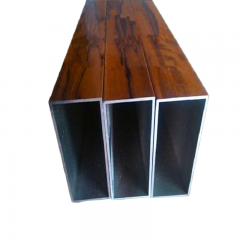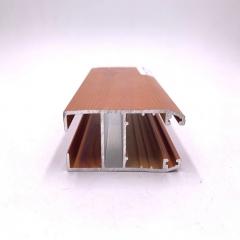
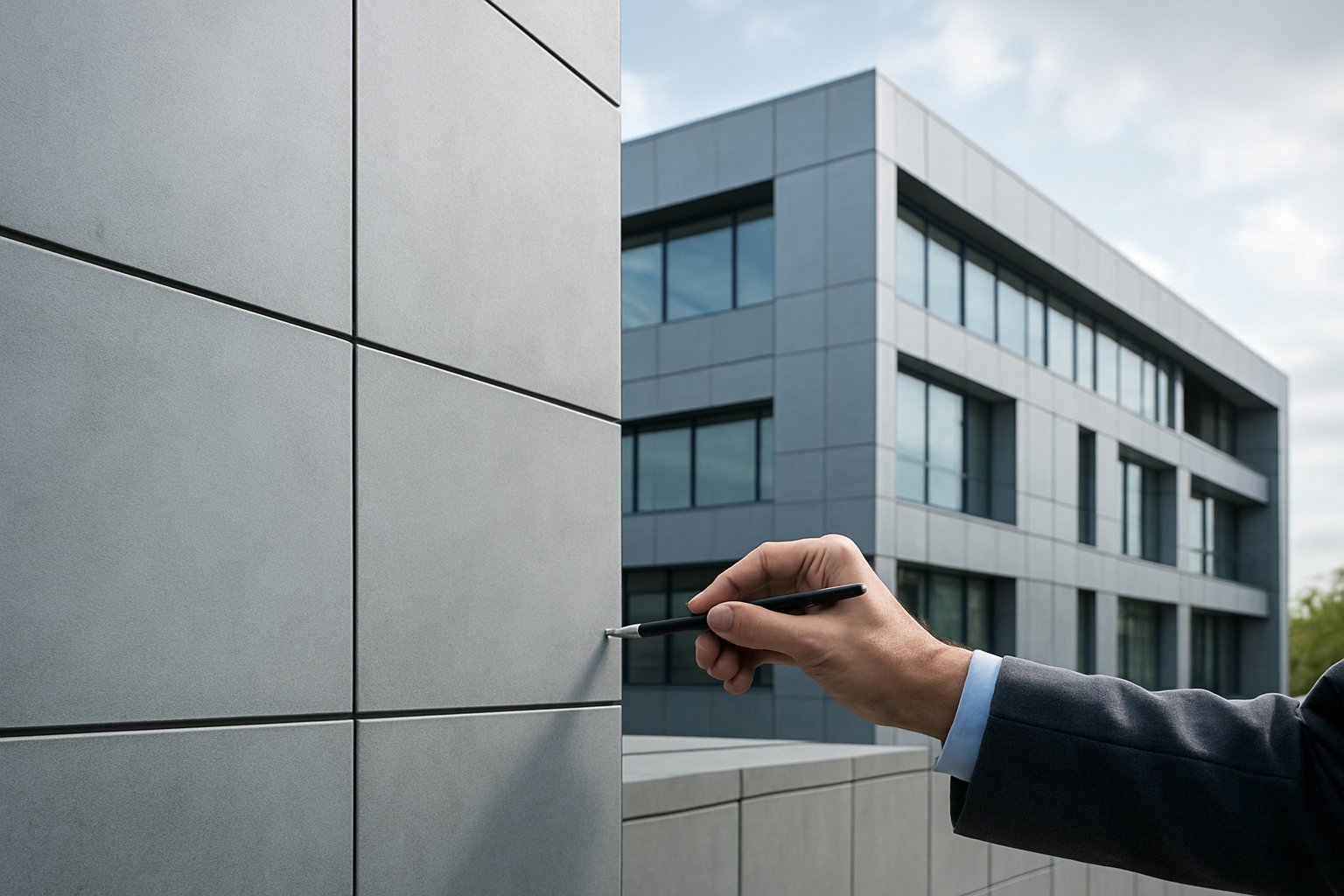
If you are asking what is PVDF coating on aluminium, the short answer is simple. It is not a type of aluminium alloy. It is not a fabrication method either. It is a fluoropolymer-based coating system applied to aluminium surfaces to improve weather resistance, color retention, and long-term appearance. Technical overviews from Alcadex and LT Coating Coil both place it firmly in the factory-applied architectural finish category.
PVDF coated aluminium is aluminium that has been finished with a polyvinylidene fluoride fluoropolymer coating system for added durability, weather resistance, and appearance retention.
That definition matters because many buyers mix up three different things:
In plain terms, pvdf coating on aluminium describes a finish applied to metal. It does not tell you the alloy, temper, thickness, or fabrication quality by itself. That is where many specification mistakes begin.
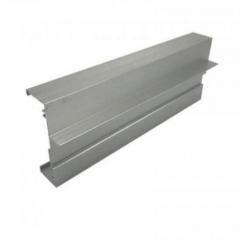
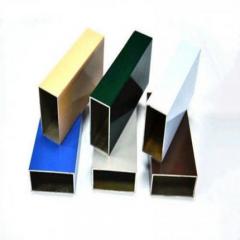
Common product forms seen in procurement and specification work include:
In the market, pvdf aluminium coating may also be called fluorocarbon coating, PVDF paint system, or simply a high-performance architectural coating. Those names often point to the same general finish family, but they still do not define the whole build. A brochure might say “PVDF panel,” yet the product could be a solid sheet, a coil-coated panel blank, or an aluminium composite panel with a PVDF-finished face.
That distinction is more than wording. When a finish fails, the cause may sit in pretreatment, primer choice, curing, or substrate condition rather than in the PVDF label alone. The coating name gets the attention, but the full system decides how well the aluminium performs.
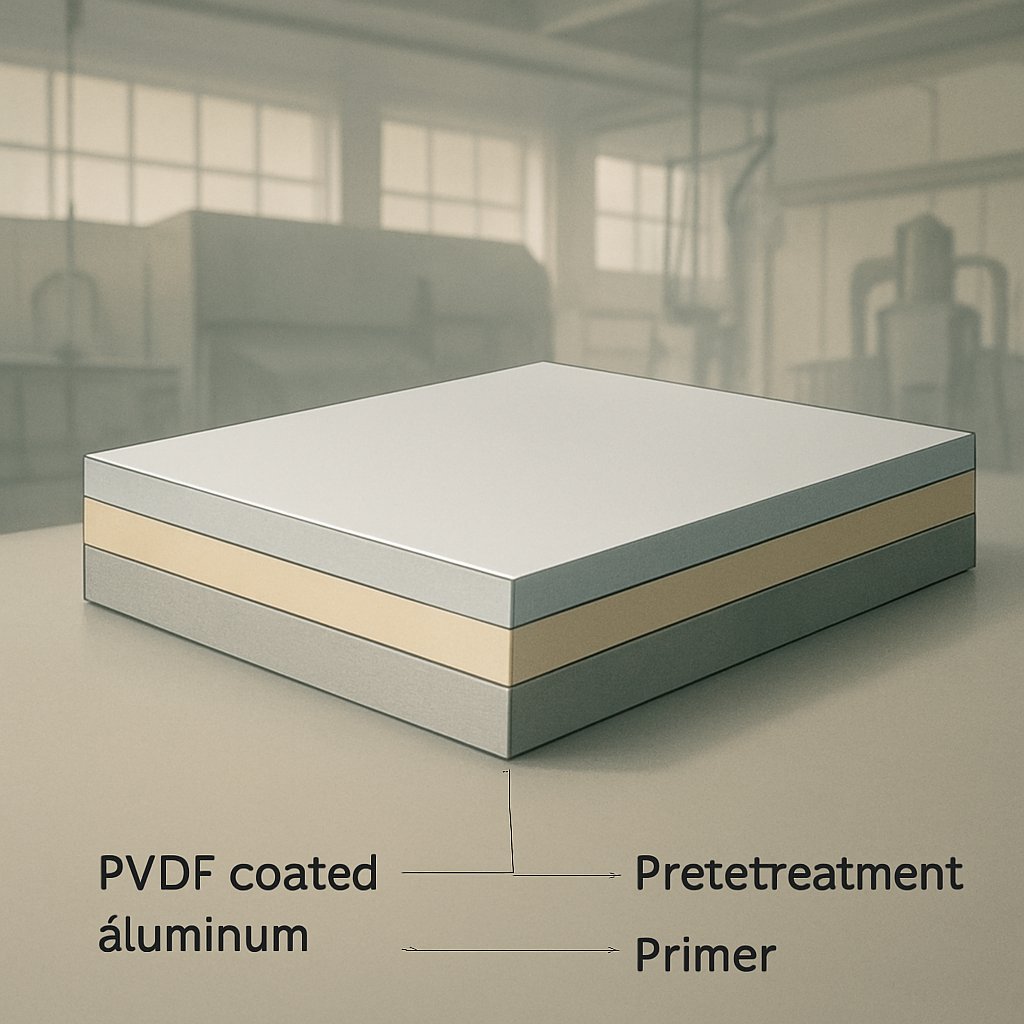
That full system has layers, and each one matters. A long warranty can make the topcoat sound like the whole story, but an aluminium PVDF coating only performs well when the metal is prepared correctly, the primer bonds properly, the finish is applied evenly, and the curing stage is controlled. This is true whether the product starts as a pvdf coated aluminium coil or the face sheet of a pvdf coating aluminium composite panel.
In simple terms, the finish is not just "PVDF paint on metal." It is a sequence. Industry process explainers from Sherwin-Williams and Wellste both describe a multi-part build that includes surface preparation, primer, topcoat, and curing. Some systems may also use a clear coat, depending on the finish design.
| System part | Main role | Why it matters |
|---|---|---|
| Pretreatment | Conditions the aluminium surface | Supports adhesion and corrosion resistance |
| Primer | Bonds substrate to finish coat | Helps film integrity, smoothness, and forming durability |
| Topcoat | Delivers color and exterior protection | Supports UV resistance, chalk resistance, and appearance retention |
A detail that often confuses buyers is the phrase 70% PVDF. In architectural market language, that usually refers to the resin portion of the coating formula, not to 70% of the entire liquid paint in the can. The full coating still includes pigments, solvents, and additives, all of which influence color, flow, cure behavior, and long-term finish consistency.
That is why two products can both be described as PVDF and still perform differently in service. One may have stronger primer chemistry. Another may have better pigment stability. A third may look fine at delivery but show uneven gloss or edge issues later because the process window was not held tightly.
For buyers, the practical takeaway is simple: do not judge the system by the topcoat label alone. Ask how the surface was prepared, how the primer is described, and how curing consistency is controlled. Those answers start to matter even more when the same coating must work across different alloys, tempers, and product forms.
The coating build explains a lot, but the metal underneath changes the outcome just as much. In real projects, the same PVDF label can sit on different aluminium products, and that affects adhesion, appearance, fabrication stress, and edge behavior. The IIBEC paper makes the basic point clearly: architectural aluminium uses alloys rather than pure aluminium, and protective finishes are added because bare surfaces remain vulnerable to corrosion.
For buyers, that means the finish should never be reviewed in isolation. A request for pvdf coated aluminium sheets, or even a search phrase like 5754 pvdf coating aluminium coil, still needs substrate questions attached to it. What alloy is being coated. What temper or forming condition is expected. What pretreatment was used before the primer and topcoat went on.
That last point matters more than many brochures suggest. The same failure review links premature problems to pretreatment changes, poor adhesion, and weaker corrosion protection when the conversion stage is wrong or inconsistent. In other words, a strong topcoat cannot fully rescue a weak bond to the aluminium surface.
Fabrication route also changes the stress picture. A coil versus extrusion guide notes that coil coatings are applied before the metal is formed, while extrusion coatings are spray applied after the profile has already been formed. That difference affects how the finish is asked to perform during manufacturing and installation.
Form factor changes risk. A pvdf colour coated aluminium sheet may arrive looking uniform, then face new stress at bends, cut edges, or exposed fastener zones. The IIBEC paper notes that filiform corrosion often starts at edges and can travel under the coating, which is one reason edge quality deserves close attention. A pvdf coated aluminium composite panel or fabricated wall panel should also be reviewed as a panel product, not treated as automatically equivalent to a curtain wall extrusion just because both use a fluoropolymer finish.
| Substrate factor | Why it matters | Likely performance concern |
|---|---|---|
| Alloy and temper callout | The coated metal is not just a paint target. It is a specific architectural substrate. | Adhesion expectations and fabrication suitability may be mismatched. |
| Coil-coated sheet | Coating is applied before forming. | Appearance shifts or coating stress can show up during later fabrication. |
| Fabricated panel or panel facing | Edges, joints, and exposure points become more important in service. | Edge corrosion risk and visual consistency across parts. |
| Extrusion or profile | Coating is spray applied after the shape is formed. | Coverage consistency on visible shapes and profile-to-profile color matching. |
| Pretreatment quality | It supports bonding and corrosion resistance beneath the finish. | Delamination, bubbling, or early corrosion despite a long warranty. |
The practical lesson is simple. Ask suppliers to discuss substrate, pretreatment, and coating system as one package. If those details stay vague, test claims, weathering language, and warranty promises become much harder to read with confidence.
Specifications start to make more sense when you stop reading PVDF as a promise by itself and start reading the proof behind it. In architectural aluminum, buyers often see AAMA 2603, 2604, and 2605 beside terms like weathering, adhesion, chalk resistance, and gloss retention. Those labels do not describe the same performance level. They mark increasingly demanding benchmarks for organic coatings on aluminum extrusions and panels, with South Florida outdoor exposure periods commonly cited at 1, 5, and 10 years for comparing long-term appearance retention.
In plain English, a standards claim tells you what a coating was tested against, not that every product using PVDF chemistry will perform identically. AAMA 2605 is the toughest of the common architectural tiers and is typically tied to severe exterior exposure, while 2603 and 2604 fit milder to moderate conditions. Weathering tests usually combine outdoor exposure with accelerated lab work because sun, humidity, pollutants, and salt can stress finishes in different ways.
Compliance language matters only when it is backed by documented test evidence for the exact coated product being supplied.
When you review a pvdf coating on aluminium sample, especially a metallic finish, look past the color chip. Special-effect pigments can shift with light and viewing angle, so appearance claims and durability claims should be read separately.
That last point is where many purchasing mistakes hide. A long warranty can still exclude cut edges, severe coastal exposure, poor maintenance, or changes that remain within stated tolerances. A lobby panel, a storefront, and a seafront facade do not ask the same thing from a finish, which is why application context matters just as much as the test claim itself.
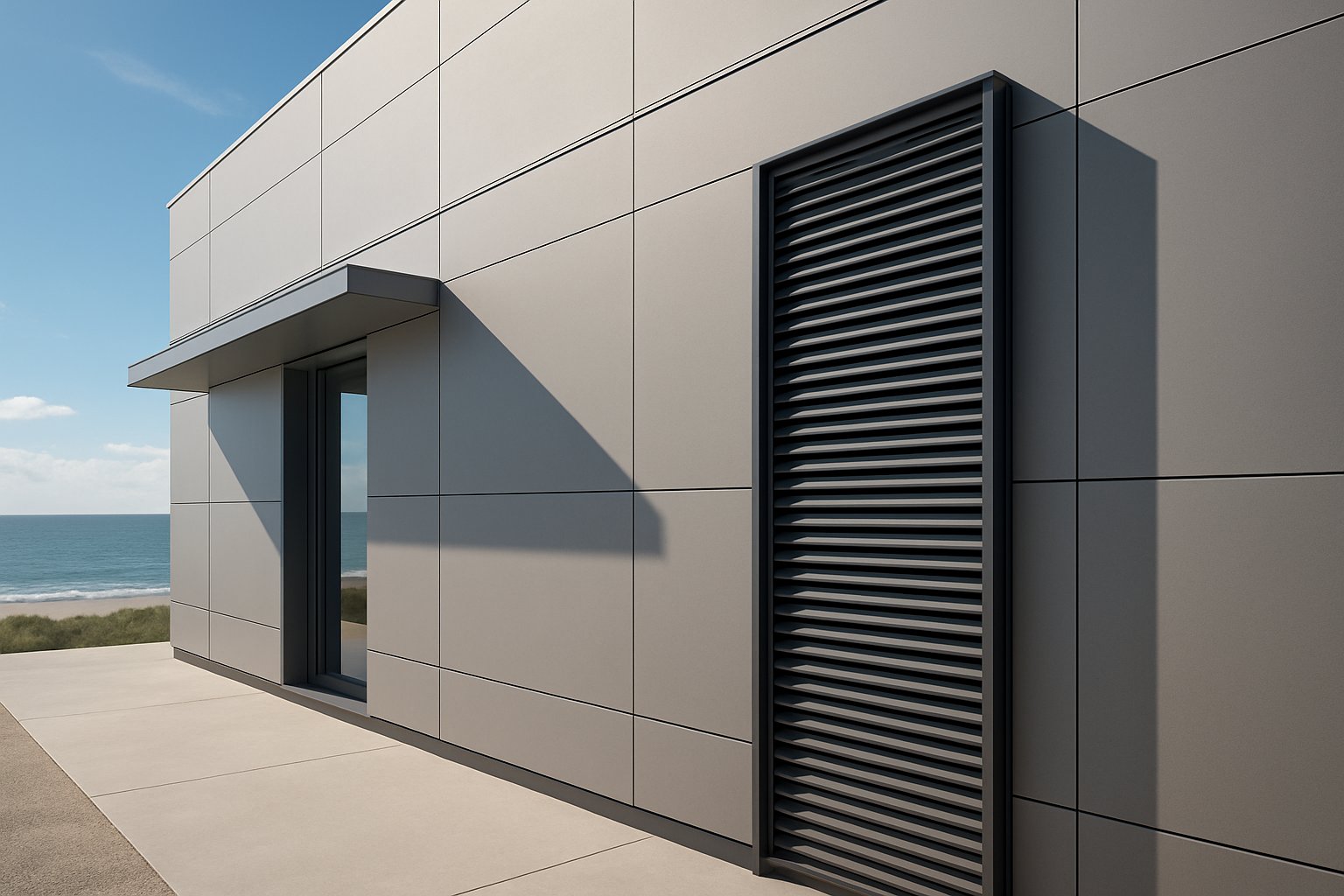
A long warranty means very different things on a sun-beaten facade than it does on a sheltered interior panel. Guidance from Yaji Aluminum, Gabrian, and BLT consistently places PVDF on exposed aluminium used in cladding, curtain wall, roofing sheet, signage, louvers, and demanding building-envelope work. The finish earns its keep where appearance and weathering both matter for years, not just at handover.
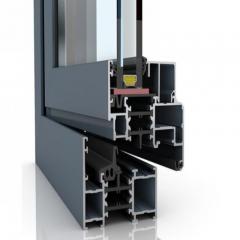
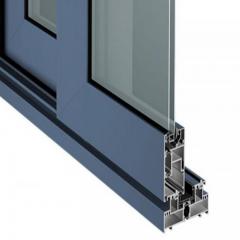
In practical terms, this usually includes facades, curtain wall elements, rainscreen and cladding panels, window and storefront framing, canopies, soffits, sunshades, louvers, and aluminium composite panel faces. Industrial and infrastructure uses also show up where chemical resistance, pollution resistance, or long outdoor service are part of the brief.
If you are comparing a pvdf coated aluminium coil supplier or reviewing wholesale pvdf coated aluminium sheet offers, start with the service environment before the color chart. A listing for china pvdf coated aluminium coil may look similar to many others, but the right fit depends on where the material will live and how visible any fading, chalking, or corrosion would be.
| Application type | Typical exposure | Finish priorities | Selection cautions |
|---|---|---|---|
| Facade, cladding, and rainscreen panels | Full sun, rain, pollution, high visibility | Color retention, gloss stability, low chalking | Best value where repainting access is difficult or visual drift would be obvious |
| Curtain wall elements and panel facings | UV, moisture, urban grime, weather cycling | Uniform appearance across large elevations | Confirm the coating system matches the panel form and fabrication route |
| Window and storefront framing | Sun, rain, condensation, daily public visibility | Weather resistance and cleanability on visible trim | Exterior framing benefits more than sheltered interior framing |
| Louvers, sunshades, and canopies | Strong UV, runoff, dirt buildup | Fade resistance, corrosion protection, lower maintenance | Edges and formed details still depend on good process control |
| Signage and ACP faces | Direct sun and constant visual exposure | Stable color and durable finish film | Check whether exposure is true exterior or only intermittent |
| Interior ceilings or partitions | Low UV, controlled conditions | Decorative appearance and budget control | A less demanding finish system may be enough |
The strongest case for PVDF shows up where sunlight, salt, humidity, and pollution combine. The same reference set describes resistance to UV-driven fading and chalking, along with protection against salt spray, acid rain, and airborne pollutants. That makes it a frequent choice for coastal buildings, high-rise facades, airports, transport-related panels, commercial signage, and industrial zones where surface failure is both visible and expensive to fix.
Not every project needs that level of finish. Interior decorative parts, low-UV spaces, or sheltered applications may not require a premium fluoropolymer system, especially when future refinishing is easy and appearance retention is less critical.
That is where PVDF makes the most sense. Where exposure is mild, the premium becomes harder to justify, and the better question shifts from performance alone to how it compares with other finish options over the life of the job.
Exposure tells you whether a premium finish is necessary. Selection pressure tells you whether it is worth paying for. That is why finish choice on aluminium should be judged as a lifecycle decision, not just a line-item price comparison.
The clearest performance split in the source material comes from three places. RoofSmart places PVDF above SMP and polyester for long-term resistance to fading and chalking, while also noting that PVDF usually costs more and can scuff more easily than SMP. Americlad ties premium fluoropolymer systems to AAMA 2605-level architectural expectations, while standard powder coatings are more commonly associated with AAMA 2604. SAF adds an important counterweight: anodizing is harder than PVDF or FEVE, cannot peel, and remains a strong choice where abrasion matters more than huge color range.
| Finish option | Relative upfront cost | Outdoor appearance retention | Scratch or abrasion behavior | Fabrication and geometry fit | Lifecycle burden |
|---|---|---|---|---|---|
| PVDF fluoropolymer | High | Very strong for color, gloss, and chalk resistance | Good weathering, but can scratch or scuff more easily than SMP and is not as hard as anodizing | Excellent for coil-coated sheet, curtain wall, roofing, and exposed cladding | Lower long-term repaint and replacement risk in harsh exposure |
| SMP | Mid-range | Lower than PVDF, with faster chalk and fade over time | Harder and more scratch-resistant than PVDF | Useful where budget matters and abuse resistance is valued | Moderate, because appearance drift arrives sooner |
| Polyester | Low | Weakest of the painted systems in these sources, best for less demanding use | Varies by formula, but not positioned as a premium exterior weathering finish | Better suited to indoor or shorter-life applications | Higher outdoors due to earlier visual aging |
| FEVE-based premium powder | Source set does not give a fixed cost rank | Can reach AAMA 2605-level performance in qualified systems | Powder application can be durable, but finish texture and orange peel must be watched | Helpful when a high-performance powder route is preferred | Potentially lower than standard powder when exterior demands are high |
| Standard architectural powder | Often economical | Good, but generally below AAMA 2605 fluoropolymer expectations | Strong against scratching and impact | Useful for interiors, budget-focused work, and projects with planned refresh cycles | Moderate to high in strong sun or coastal settings |
| Anodized aluminium | Generally less expensive than painting, except coil painted products | Not a paint film, so it offers a different aging profile and strong metallic permanence | Very hard, abrasion-resistant, and cannot peel or flake | Excellent for storefront and high-traffic components; color range is more limited | Low in abrasion-heavy service, but shade variation and chemical exposure need attention |
| Bare mill finish | Lowest finish-system spend | No applied architectural coating system to preserve color or gloss | No paint film to chip, but also no paint-system protection claim | Best only where an unfinished look is intentional | High if appearance control is important later |
In plain language, PVDF earns its premium when the aluminium is highly visible, hard to replace, and exposed to UV, weather, salt, or pollution for years. That is the point many aluminium pvdf coating wholesale conversations miss. A cheaper finish may reduce the first invoice, then give back the savings through faster fading, more obvious mismatch, or earlier refinishing pressure.
That is why a quote from an aluminium pvdf coating wholesaler, or even a china aluminium pvdf coating wholesaler, should be normalized against exposure, geometry, maintenance expectations, and finish class before price is treated as a true comparison. The finish family on the brochure is only half the decision. The other half sits in supplier evidence, sample control, and process discipline.
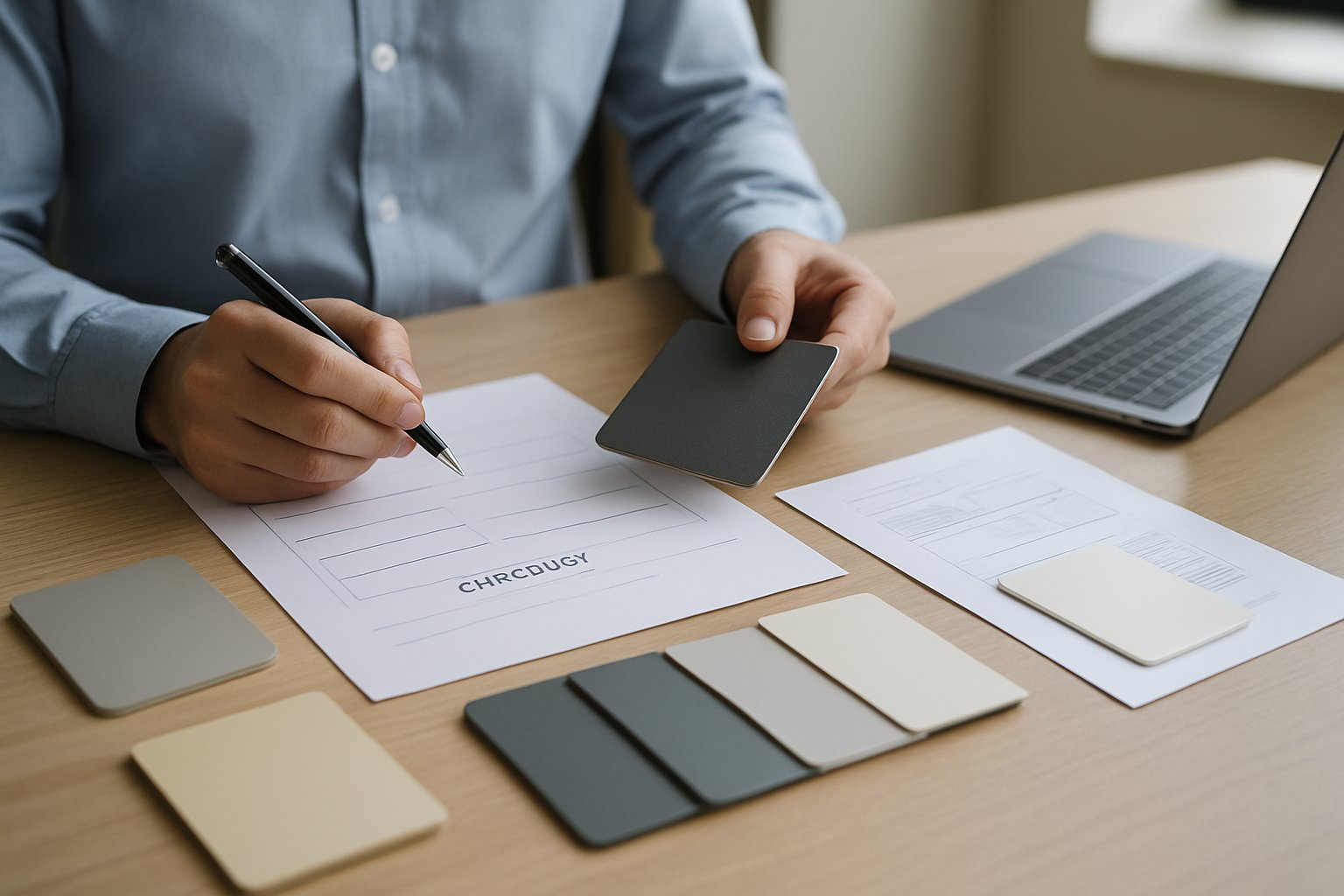
Supplier evidence is where a finish specification either becomes real or falls apart. A search for an aluminium pvdf coating manufacturer or an aluminium pvdf coating supplier in china will return plenty of similar claims. The shortlist gets sharper when you ask for records, not slogans. The supplier should be able to connect alloy choice, pretreatment, coating build, testing, and warranty into one traceable process.
Both the Prance guide and the JEELIX guide point to the same discipline: qualify the factory before you trust the warranty.
Samples are not just color chips. They are evidence of process stability. When screening an aluminium pvdf coating factory, a china aluminium pvdf coating factory, or a china aluminium pvdf coating manufacturer, review the package like this:
If samples, test reports, and warranty wording do not point back to the same controlled process, the risk still sits with the buyer.
Those supplier answers usually become the backbone of a better RFQ, where exposure, substrate, pretreatment confidence, coating evidence, and documentation are spelled out in the right order.
A strong RFQ is simply the supplier checklist turned into written requirements. That matters because the finish that looks identical on a quote sheet can perform very differently in service. The KGE PVDF guide frames the real selection logic well: this coating is typically chosen for aluminium in harsh UV, coastal, polluted, or chemically exposed environments where long-term appearance and lower maintenance matter most.
Start with exposure, not product labels. If the component sits on a facade, curtain wall, roof edge, or other highly visible exterior area, the risk of fade, chalk, corrosion, and repainting disruption rises fast. If it is interior and sheltered, the same premium system may be unnecessary. For buyers reviewing aluminium pvdf coating in china offers, or screening an aluminium pvdf coating manufacturer in china, the brief should state where the metal will be used, how visible it is, and what failure would cost after installation.
PVDF performance depends on the whole system: the aluminium substrate, pretreatment quality, coating build, curing control, and the evidence behind the warranty.
Good sourcing documents reduce guesswork. They also make quotes easier to compare across an aluminium pvdf coating factory in china, an aluminium pvdf coating wholesaler in china, or an aluminium pvdf coating wholesale in china listing.
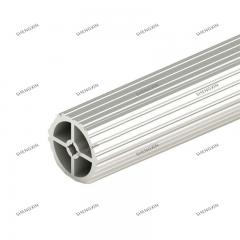
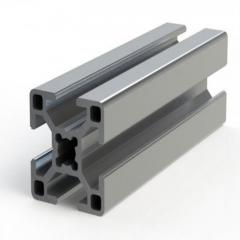
If your project also includes custom aluminium extrusions, or you need to compare PVDF-coated products with precision powder-coated profiles, Shengxin Aluminum is a practical reference point. Its published capability includes 30 years of manufacturing experience, extruders up to 5500T, and support for large custom architectural and industrial profiles. Used that way, the resource helps you compare process capability, not just finish names.
PVDF coated aluminium is aluminium finished with a fluoropolymer paint system, usually for better outdoor durability and more stable appearance over time. The key point is that PVDF names the coating chemistry, not the alloy, temper, or product form. A sheet, coil, panel, or profile can all carry a PVDF finish, but performance still depends on the full coating system and the quality of the aluminium underneath.
A long warranty does not automatically prove that every layer of the finish system was controlled well. Problems often start earlier, such as weak pretreatment, poor primer bonding, uneven curing, edge exposure, or a mismatch between the coating system and the substrate being formed or installed. Warranty language may also exclude coastal conditions, cut edges, maintenance issues, or appearance changes that remain within stated tolerances.
Not always. PVDF is often a strong choice for highly visible exterior aluminium that faces UV, rain, pollution, or coastal exposure, especially when repainting later would be costly. But other finishes can make more sense in specific situations, such as anodized surfaces for harder abrasion resistance or powder coating for certain profile geometries and budget targets. The right finish depends on exposure, appearance goals, maintenance burden, and the shape being coated.
Ask for more than a color card or a generic claim that the finish is PVDF. Buyers should confirm alloy compatibility, pretreatment method, primer and topcoat description, cure control records, sample approval process, test documentation, batch consistency, and the exact wording of the warranty. If a project also includes extrusions, it is useful to compare profile-coating capability too. For that kind of evaluation, Shengxin Aluminum is a practical reference because it publishes details on large-profile extrusion capacity and precision powder coating for architectural and industrial applications.
PVDF is usually easier to justify when the aluminium will stay outdoors for years, remain highly visible, and be expensive to repair or replace after installation. Typical examples include facades, curtain wall components, rainscreen panels, louvers, and exposed trim in strong sun or coastal air. In low-UV interior spaces or projects with easy future refinishing, a simpler finish system may be enough.



 Интернет Сервис
 0086 136 3563 2360
 sales@sxalu.com
 +86 136 3563 2360
 русский
 English
 français
 Deutsch
 español
 português
 العربية
 ไทย
ไทย Việt
Việt Українська