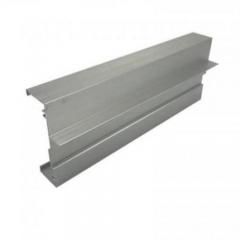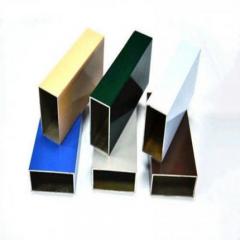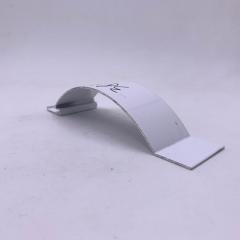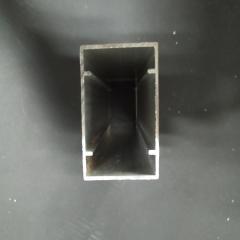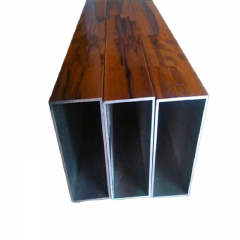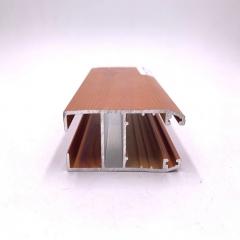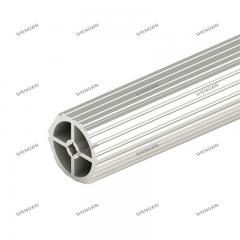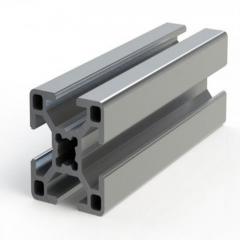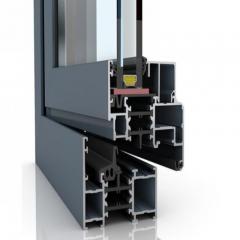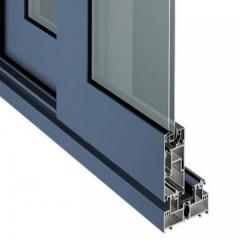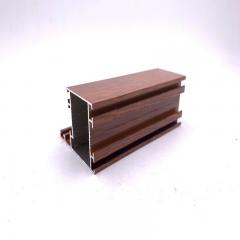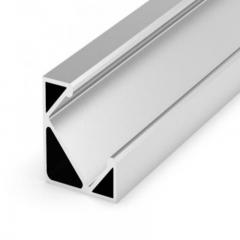
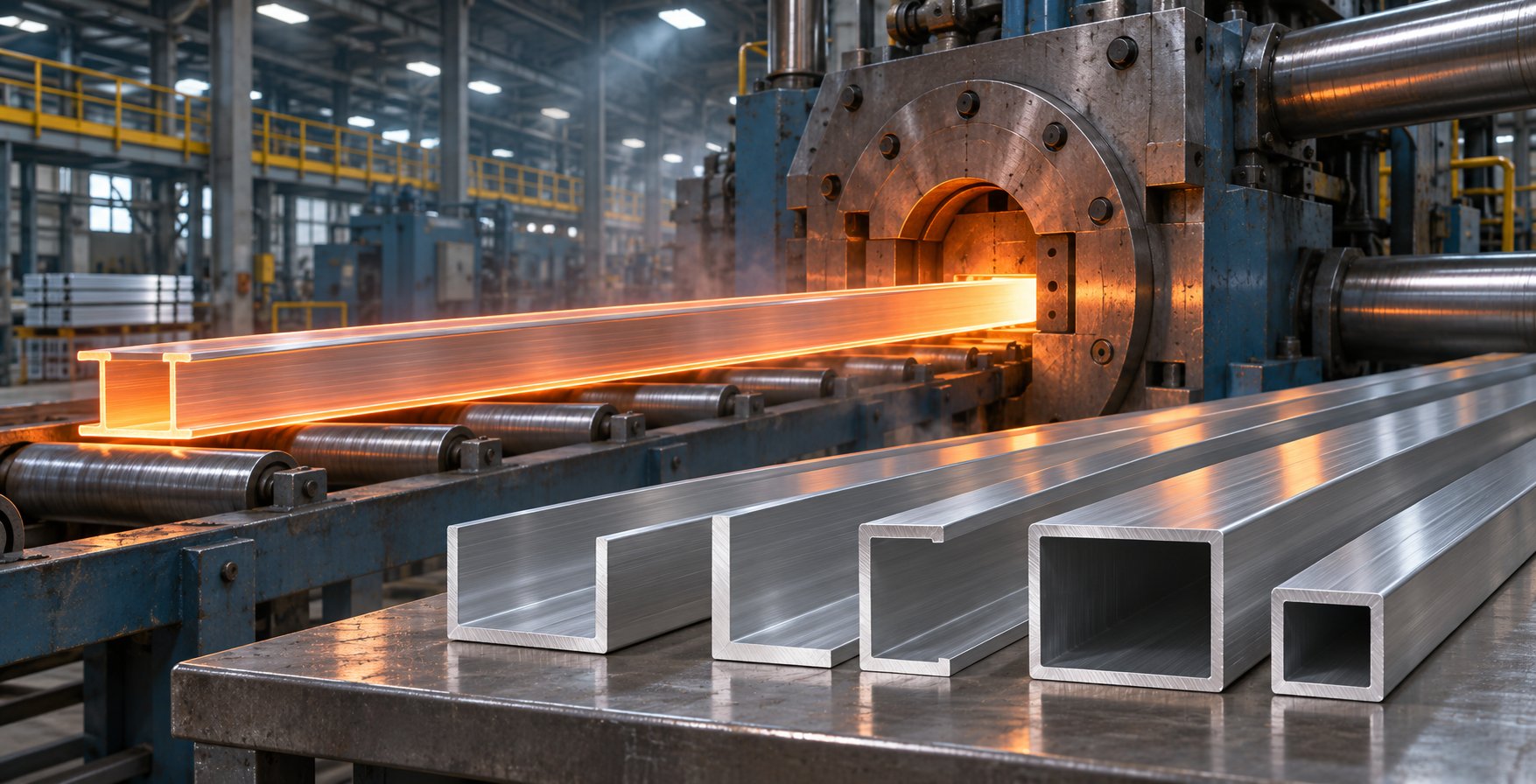
Custom hard alloy extrusions are profiles extruded to a buyer-specific cross-section from high-strength aluminum alloys, mainly the 2xxx and 7xxx series. These alloys are harder to push through a die than common 6xxx alloys, and that difficulty shapes the design limits, the price and the lead time.
Have you ever sent a drawing to an extruder with 7075 called out and gotten back a quote far higher and slower than you expected? This guide explains why that happens. Hard alloy profiles go into parts where loads are high and weight is tight, such as wing spars, fuselage frames and other structures that take years of vibration and cyclic loading. Taber Extrusions notes that the 2xxx and 7xxx series provide the strength these parts need. The softer 6xxx alloys used in architectural and automotive work are not engineered for sustained high stress.
The term "hard alloy" has two meanings, and search results often mix them up. In aluminium extrusion, it means the high-strength 2xxx and 7xxx alloys. Some extruders also put high-magnesium 5xxx alloys in this group. In translated sources, "hard alloy" comes from the Chinese term yingzhi hejin and the Russian term tvyordy splav, and both mean cemented carbide, such as tungsten carbide. This article covers only the aluminum meaning. If you need extruded cemented carbide rods or preforms, you're looking for a separate product category with its own suppliers.
A custom extrusion is a profile made from a die built for one buyer's drawing. A standard profile comes from a die that already sits in a manufacturer's library, so you can order it from a catalog. Profile Precision Extrusions sums up the trade-off. Catalog shapes ship fast and need no tooling, but the selection is limited and the tolerances are looser. Custom aluminum extrusions add a one-time die cost. In return, you get a cross-section designed around your part. Picture a frame rail that needs a mounting slot, a stiffening rib and a cable channel. Starting from a catalog shape, you would have to machine all of those features in. A custom die can extrude the whole cross-section directly.
To keep the comparisons consistent, every later section rates aluminum extrusion profiles against the same four alloys:
On a drawing, these four alloy numbers look interchangeable. On the press floor, they behave very differently. The gap only becomes clear when you put strength and extrudability side by side.
Which alloy should go on your drawing? Most guides answer with a strength chart and stop there. For a custom profile, a strength chart covers only half the decision. The alloy also sets how fast the press can run, how much detail the die can hold and how many extruders can quote the job. The hard alloys among aluminum alloys for extrusions fall into three families.
Copper is the main alloying element in the 2xxx series. These alloys are heat treatable and strong, but they resist corrosion less well than 6xxx alloys. In service they are often clad or coated, as this alloy grade reference explains. 2024 is the fatigue specialist. Its typical fatigue strength of 138 MPa compares with 96.5 MPa for 6061-T6, so it shows up in high-stress fittings and parts under cyclic load. Fusion welding of 2024 is generally avoided because the heat-affected zone cracks. When a 2xxx part must be welded, designers turn to 2219, the weldable member of the family. 2014 covers heavily loaded structural parts where high strength matters more than corrosion behavior.
Zinc, usually combined with magnesium and copper, gives the 7xxx series the highest strength of the common wrought alloys. Composites now make up more of the airframe, but a 2023 aerospace review still calls high-strength aluminum indispensable, and aircraft extrusion work relies heavily on this family. 7075 goes into wing spars, fuselage frames and landing gear components. Where stress corrosion cracking is a risk, engineers specify the overaged T73 or T7351 tempers. These tempers give up roughly 10 to 15% of the strength in exchange for much better resistance. 7050 appears in aerospace aluminum extrusions and thicker sections that need toughness and stress corrosion resistance as well as strength. 7068 pushes strength higher still and suits small, highly loaded sections. Fewer extruders run 7068, so confirm availability before you design around it.
Why would an alloy that can't be heat treated count as hard? The 5xxx alloys get their strength from magnesium and strain hardening, which is what the H tempers indicate. That high magnesium content also makes the billet harder to deform, so these alloys extrude slowly. MAADI Group lists 5083 for welded ship hulls, marine structures and pressure vessels, and 5456 for welded marine structures and storage tanks. Most 5xxx marine work uses rolled plate, so extruded 5xxx profiles are a smaller niche.
The table ranks extrudability from easiest to hardest instead of giving index numbers, because the reference sources do not publish verified index values.
| Alloy | Temper | Typical Yield Strength | Relative Extrudability | Typical Uses |
|---|---|---|---|---|
| 6063 | T5 | About 145 MPa (21 ksi) | Highest (baseline) | Architectural profiles, heat sinks, trim |
| 6061 | T6 | About 276 MPa (40 ksi) | Good | Machine frames, structural extrusions, manifolds |
| 2024 | T3 | About 345 MPa (50 ksi) | Low | Aerospace fittings, truck wheels, high-stress machined parts |
| 7075 | T6 | About 503 MPa (73 ksi) | Lowest | Wing spars, fuselage frames, landing gear parts |
These are typical values, not design minimums. Extruded 2024 and 7075 usually ship in stress-relieved tempers such as T3511 and T6511. The guaranteed properties of any aluminum extrusion profile depend on temper and wall thickness. Check each figure against Aluminum Association standards data and ASTM B221 or the governing AMS specification, then confirm the actual values on the mill test report.
Moving from 6061-T6 to 7075-T6 raises typical yield strength by about 80%. The metal also resists deformation harder inside the press, and much of the extra cost begins there.
2xxx and 7xxx alloys give far more strength than 6061, but you pay for it with slower production, tighter design limits and higher cost.
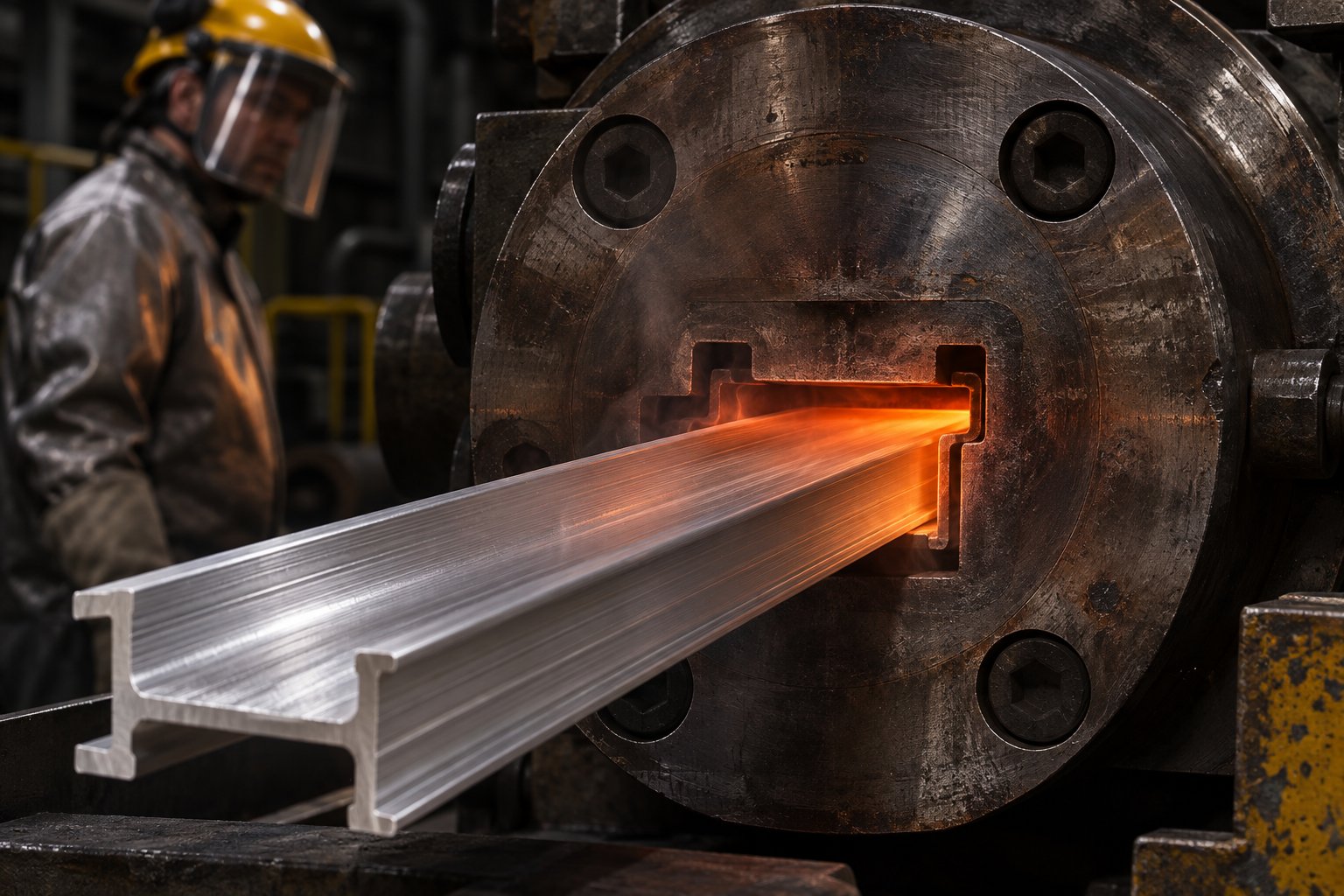
Why would a press that runs 6063 all day struggle with a 7075 profile of about the same size? A recent Materials Transactions study describes 7xxx alloys as having poor extrudability. The causes form a chain, and each link adds risk to the profile. Capable extruders manage that chain with three custom hard alloy extrusion techniques: billet temperature control, ram speed control and die bearing design.
In aluminum profile extrusion, flow stress is the stress needed to keep hot metal deforming. In 7075, zinc, magnesium and copper atoms and fine precipitates block the movement of dislocations inside the metal, so the billet resists flow far more than a 6xxx billet does. The copper in 2024 has a similar effect. Higher flow stress raises the breakthrough pressure, which is the peak load needed to start metal moving through the die. As a result, a press that handles a wide, thin 6063 section may only manage a smaller or simpler shape in 7075.
The load estimate has to be accurate. In the same study, simulation software using its default 7075 data underpredicted extrusion force by 19.16%, and the authors warn that an error like this can lead to choosing an undersized press. A model calibrated on the actual billet batch came within 1.11%.
A large share of the work done on the metal turns into heat, mostly at the porthole entries and die bearings. With 6063, the extruder has room to absorb that heat and still run fast. Hard alloys leave a much narrower working range. If the billet runs too hot, deformation heat pushes the metal toward incipient melting and the surface tears. If it runs too cold, flow stress climbs until the press stalls. The usual fix is to slow down. In the study, a complex hollow 7075 curtain wall profile ran at a ram speed of about 0.1 mm/s on a 2100-ton press. At that speed the metal stays in the die much longer than it would in typical 6xxx extrusion, which gives the tooling time to draw heat away. That figure comes from one difficult shape and is not a general rule for hard alloys.
When speed or temperature drifts too high, the surface tears. This hot shortness shows up as cracks running across the profile, often at corners and thin walls. Die wear costs more slowly. Earlier work on a 7005 porthole die found die damage and material blockages with conventional H13 tool steel. For 7075, the researchers moved to a higher-molybdenum tool steel with gas nitriding. In simulation, it cut peak die stress by 6 to 8%, and its hardened surface resists the galling that hot aluminum causes on bearings.
The causes build on each other in this order. Each one has a direct effect on extruded profiles:
Across all six causes, 6063 profile extrusions are at the forgiving end. 6061 needs tighter control. 2024 and 7075 are at the hard end, and 7075 leaves the least margin.
The designer feels these press limits as well as the extruder. They come back as rules about wall thickness, corner radii and section size. Saha's ASM chapter on extrusion of hard alloys, for example, relates minimum wall thickness to circumscribing circle diameter.
Imagine you copy a proven 6063 profile onto a new drawing and change only the alloy callout to 7075. The die designer will probably send it back with questions. The flow stress problems described above become geometry rules, so hard alloy extruded shapes need thicker walls, softer transitions and simpler voids than the same part in 6063. Published guidance such as the Aluminum Extruders Council design tips was written for general profiles. For 2024 or 7075, read its numbers as the starting point for easy alloys. They are not targets you can safely draw to.
Wall thickness. Metal flows faster through thick sections of a die than through thin ones. The AEC warns that sharp thick-to-thin changes can distort the profile, break the die and mark the surface. A stiff 7075 billet needs more pressure to fill a thin wall, so the minimum wall goes up and changes in thickness need gradual tapers.
Corner radii. Sharp corners concentrate stress in the die and slow the metal. For general profiles, the AEC gives minimum radii of 0.020 in (about 0.5 mm) for outside corners and 0.015 in (about 0.4 mm) for inside corners. Hard alloys tend to tear at corners first, so expect the extruder to ask for larger radii.
Tongue ratio. The tongue ratio is the area of a partly enclosed void divided by the square of its gap width. A high ratio means a large die tongue sitting on a thin neck. A hard alloy pushes on that tongue with more force, so the highest ratio the die can survive is lower.
| Design Feature | 6063 Baseline | 6061 | 2024 | 7075 |
|---|---|---|---|---|
| Minimum wall thickness | Thinnest practical walls | Slightly thicker | Thicker | Thickest of the four |
| Corner radii | AEC minimums usually workable | Slightly more generous | More generous | Most generous |
| Thick-to-thin transitions | Gradual change advised | Gradual change advised | Longer tapers needed | Longest tapers, no steps |
| Tongue ratio | Highest allowable | Slightly tighter limit | Tighter limit | Tightest limit |
| CCD on a given press | Largest | Large | Smaller | Smallest |
| Hollows from porthole dies | Routine | Routine | Limited, confirm with extruder | Often specified seamless |
The entries rank the alloys against each other. They are not limits you can design to. The actual minimums depend on the extruder's press, container size and experience with that alloy, so ask for them in writing.
The circumscribing circle diameter (CCD) is the diameter of the smallest circle that fully encloses the cross-section. The AEC says most profiles in common use fit inside 12 in and that the economics favor a CCD between 1 and 10 in. Those figures describe the general market. A hard alloy billet needs more pressure for every square inch of section, so the same press produces a smaller CCD in 7075 than in 6063.
This sets which aluminum extrusion sizes are realistic. Taber Extrusions notes that when press capacity is limited, designs end up with thicker walls, segmented assemblies, secondary weldments and longer lead times. Taber positions its 10,000-ton press as the way to reach wider circumscribing circles in 2024 and 7075. Few presses of that size exist, so every inch you add to large aluminum shapes in hard alloys cuts the number of extruders who can quote the job.
Porthole and bridge dies split the billet around a mandrel, and the metal joins again inside the die. Profile Precision Extrusions explains that this leaves weld seams running the length of the profile, and that those seams can be a source of weakness. Seams in 6063 and 6061 are acceptable for most work. In 7xxx alloys, the high flow stress makes the metal rebond less reliably, so a seam can be weaker than the surrounding metal.
For this reason, hollow aluminum extrusion shapes in 7xxx are often specified as seamless. They can be made by piercing the billet with a mandrel, by extruding a hollow billet over a mandrel, or by indirect extrusion. In piercing, the mandrel tip forms the inside diameter and the metal flows between the die and the mandrel without separating. These methods usually produce one simple void, such as a round or rectangular tube. A 7075 profile with several cavities may therefore need to become an open shape, a 6061 part or a machined part. For many custom hollows, the seam requirement is what decides the design.
Review these drawing features with the extruder before the die is designed:
A die built to these limits gets the cross-section right. The profile's strength, straightness and surface still depend on what happens to it after it leaves the press.
A 7075 profile leaving the die is not finished yet. It gets its final strength from heat treatment, and for hard alloys that step often happens well away from the press. The heat treatment route you choose affects the profile's strength, straightness, surface and lead time.
Heat-treatable alloys reach full strength in two steps. First comes solution heat treatment and a quench, then aging. Hydro's guide to temper designations notes that for most extruded profiles, the solution step is not a separate operation. The metal is already hot when it leaves the press, so cooling it right at the press exit does the job. This is called press quenching, and it works for 6063 and many 6061 profiles.
Many 2xxx and 7xxx profiles can't rely on press quenching. They are reheated in a furnace, held at the solution temperature and then quenched. The quench has to be fast. In a Thermal Processing article on quenching basics, D. Scott MacKenzie explains that a slow or delayed quench lets the alloying elements precipitate on grain boundaries, which lowers strength, ductility and toughness. 7075 is quench sensitive, so a delay before the quench costs it mechanical properties. A slow quench hurts 2024's strength less, but it can still reduce its corrosion resistance. Fast quenching causes its own problem, because residual stress and distortion rise with quench rate. For 7xxx alloys, quench rates above about 100 degrees Celsius per second add no strength, but they do add warpage. A separately treated profile therefore needs extra handling, straightening and schedule time.
| Alloy and Temper | Process Route | Where Solution Treatment Happens | Typical Yield Strength |
|---|---|---|---|
| 6063-T5 | Cooled from extrusion, artificially aged | No separate solution step | About 145 MPa |
| 6061-T6 | Solution heat-treated, artificially aged | Often at the press exit | About 276 MPa |
| 2024-T3 | Solution heat-treated, cold worked, naturally aged | Often a separate furnace | About 345 MPa |
| 7075-T6 | Solution heat-treated, artificially aged | Often a separate furnace | About 503 MPa |
Expect 7075 and 2024 profiles to look different from 6063, and agree on this before the first samples arrive. Surface tearing from the narrow temperature window is more likely in hard alloys. So are die lines from heavily loaded bearings and marks from the extra furnace, quench and straightening steps. A bright, uniform cosmetic surface is normal for 6063, but you shouldn't assume it for hard alloys.
Finishing needs the same attention. Results for a high-strength anodized aluminum extrusion depend on the alloy family, and Hydro notes that alloy and temper both change how a profile looks after anodizing. An alloy comparison from RPD reports that the copper in 2024 causes color variation, blotches and uneven film thickness. It also limits 7075 to functional hard coat anodizing, not decorative anodizing. 6xxx alloys anodize much more evenly, and that is a large part of why 6063 is the usual alloy for architectural aluminum extrusions. Confirm finish compatibility with your supplier for each extruded aluminum alloy before you release the drawing.
Sometimes the drawing ends up marking most faces for machining anyway. In that case the die is doing less of the work than it seems to, and cutting more of the part from solid stock may make sense.
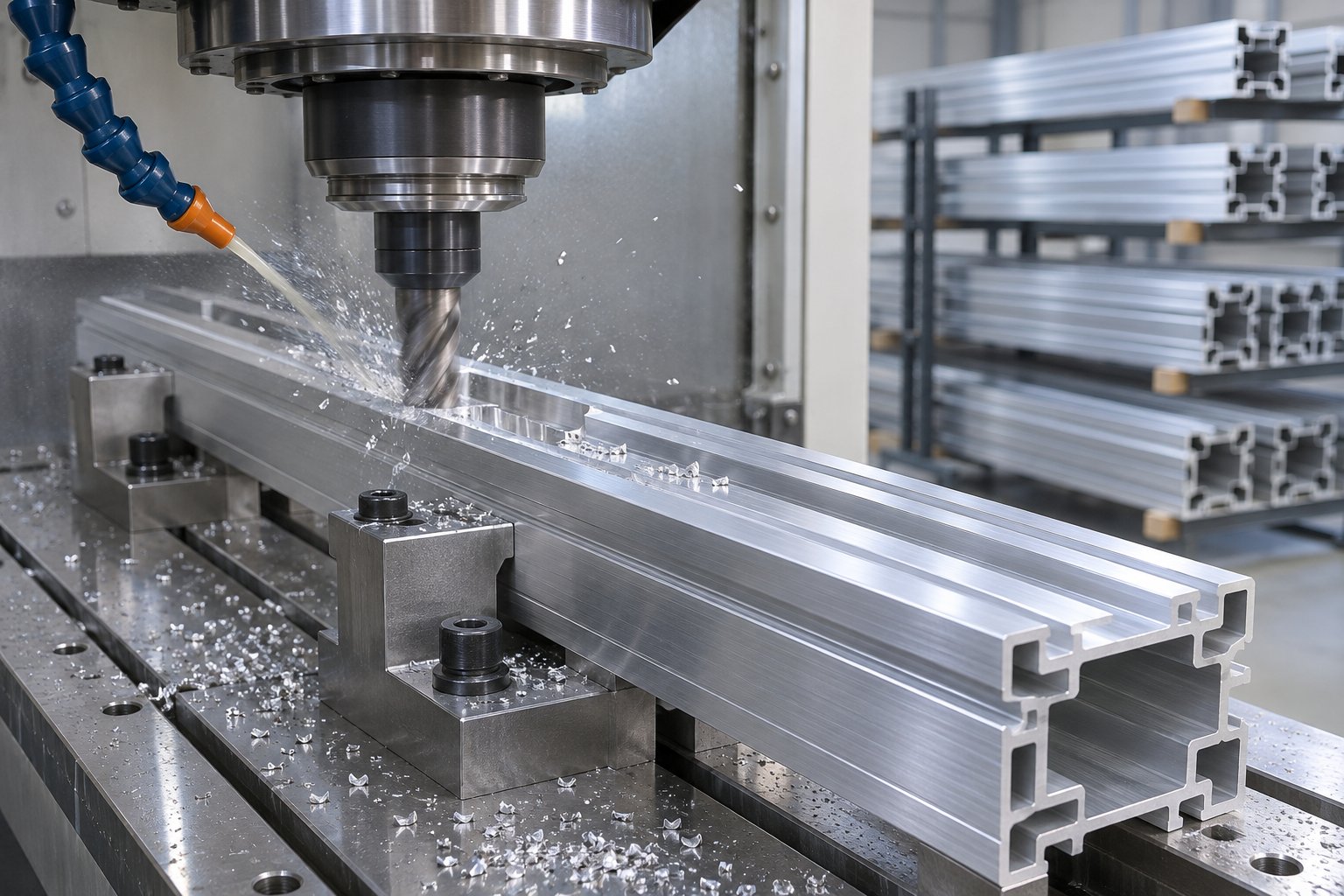
Say you have a drawing for a 7075 rail. Should you pay for a die, or cut the part from bar? Usually the answer is a mix of both. A 6CProto guide sets out the basic trade-off. Extrusion makes long, constant-section profiles cheap at volume, but it needs a die and limits how complex the features can be. Machining handles complex features and tight tolerances at low volume, but it wastes material on long, simple sections. Hard alloys make both sides of that trade-off more extreme.
Extrusion pays for its die when three conditions line up. First, the part is long and keeps the same cross-section along its length, as rails, frames and spars do. Second, orders repeat, so the die cost is spread over enough material. Third, the part benefits from the way extrusion works the metal. The process stretches the grain along the length, which suits members loaded mainly along their axis. Walls, slots and hollows built into the die are also features nobody has to machine later. The Aluminum Extruders Council points out that once you count those designed-in features, a custom part may cost less than a machined standard shape. The Council also says standard aluminum extrusions from a catalog still make sense for one-off applications.
Cutting the part from stock is the better choice in these cases:
The quantity at which extrusion becomes cheaper than machining depends on section complexity, part length and machining time. Calculate it for your part instead of assuming it.
Many hard alloy parts take a hybrid route. The extruder produces a near-net profile, meaning one that is already close to the finished shape. Secondary machining of the aluminum extrusions then adds cross holes, pockets, threads and tight-tolerance mating faces. Paramount Extrusions explains that this moves work from the CNC machine to the die. Compared with cutting the part from oversized solid stock, there is less metal to remove, so cycle times are shorter, tools wear less and the job produces less scrap. The extrusion forms the cross-section and the machining forms the functional features, so the critical dimensions no longer depend on extrusion tolerances.
Watch for two problems with this route. First, Paramount warns that packing too much complexity into the profile can slow the press and raise tooling cost until it outweighs the machining you save. Hard alloys reach that point sooner than 6063 does. Second, plan when the part gets finished. If you anodize after aluminum extrusion machining, the machined faces are coated evenly. If you anodize first, the cut faces are left bare.
| Route | Best For | Volume Fit | Geometry Fit | Main Limitation |
|---|---|---|---|---|
| Standard Aluminum Extrusions | One-off parts and simple bars, tubes or angles | Any volume, including single pieces | Catalog sections only | Limited catalog range, which can be narrower in 2024 and 7075. Added features must be machined. |
| Custom Extrusion | Long parts with built-in slots, ribs or hollows | Repeat volumes that justify a die | Constant cross-section within the alloy's design limits | Design limits tighten from 6063 to 7075, and the die adds lead time |
| Machining From Stock | Complex 3D parts, the tightest tolerances and prototypes | Very low volumes or designs that are still changing | Any shape the machine can reach | Material waste and machine time on long, simple sections |
| Hybrid | Hard alloy rails, frames and housings with precise interfaces | Production volumes | Constant cross-section plus machined cross features | Two process steps, split tolerances and a planned finishing sequence |
Here is how the four reference alloys usually fit the table. A 6063 part can often be finished almost entirely by the die. 6061 parts commonly go hybrid. For 2024 and 7075, a more complex section pushes the part toward the hybrid route or toward machining from stock. To compare routes for a specific part, 6CProto suggests quoting it three ways: extruded, machined, and extruded plus machined, each at your real quantity. For a 7075 part, the extruded quotes often come back higher and slower than the same profile in 6061. Each item on those quotes traces back to something that happens at the press.
Why does the 7075 version of a profile come back at a higher price and a later date than the same shape in 6061? Each extra line on that quote comes from one of the press limits covered earlier. If you know which cause drives which line, you can tell which costs are fixed and which ones you can negotiate.
Few extruders publish tooling prices. Profile Precision Extrusions is one that does. Its dies run roughly $1,200 to $2,500 and take about four weeks to build. Samples ship about two weeks after that. Production lead time starts only after you approve the samples. Treat these figures as a baseline for small, general-purpose aluminum extrusion die work, which at that shop is mostly 6063 and 6061. They are not hard alloy prices. Even within that baseline, the company notes that multi-void designs need special steels and more fabrication time, so those dies cost more.
A hard alloy die usually costs more and takes longer for four reasons:
Ask the extruder to price these items separately so you can see where the money goes.
Profile Precision Extrusions lists alloy and temper among the main drivers of part cost, because some alloys extrude faster than others. Tight tolerances also add cost, since less allowed variation means slower production or more scrap. Hard alloys make both effects larger. On a custom extrusion quote in 2024 or 7075, the effects show up as follows.
| Process Cause | What It Affects | Effect on Quote |
|---|---|---|
| Slow exit speed | Press hours per kilogram | Each kilogram occupies the press longer, so more press-hour cost goes into every piece |
| Die wear | Tooling replacement and requalification | Replacement dies and new sample approvals show up as tooling charges or a higher piece price |
| Lower recovery per billet | Scrap and material cost | Torn or out-of-tolerance lengths are scrapped, and that metal is still paid for |
| Separate solution heat treatment | Added operations and lead time | Furnace, quench and straightening steps add charges and schedule time |
| Limited press availability | Scheduling and supplier choice | Fewer extruders can quote, so you get less price competition and wait longer for press time |
Several of these costs come from equipment the buyer never sees: press tonnage, solution furnaces and the die shop. For a high-volume OEM, that raises a fair question. Would it cost less to own the press?

If you buy hard alloy profiles every month, owning the press can look attractive. You would control the schedule, keep the process knowledge inside your company and stop paying a supplier's margin. Before you price an aluminum extruder, add up everything that has to come with it.
The press is the biggest single purchase, but it is only one part of the line. An alu extruder also needs billet heating furnaces, a puller and runout table, a stretcher for straightening, saws, handling equipment and aging ovens. You also need a die shop to build, nitride and repair tooling, plus metallurgy and quality staff to keep the process within its limits. Newburgh Metals describes the general rule for any metal process. In-house production pays off when work is steady and high in volume. Idle machines still cost money, and skilled operators are hard to hire and keep. Its advice is to compare the two options on cost per finished part, with every expense counted on both sides.
Hard alloys make the in-house case harder. For the same section, 2024 and 7075 need more press tonnage than 6063. They also need tighter control of billet temperature and ram speed, and they often need a separate solution heat treatment furnace with a fast quench. A press sized for 6063 work may not be able to push the hard alloy profile that justified buying it.
Most OEMs outsource. Die development, extrusion, heat treatment, machining and finishing each take specialist skills. What the buyer actually needs is a profile that comes out the same in every lot. Tooling belongs inside that workflow. The extruder designs the die from your drawing, runs the trials and reworks the die as it wears.
Shengxin Aluminium is one example of this model. Its custom aluminum extrusion services combine drawing review, alloy selection, die development, extrusion, machining and finishing in one workflow. Shengxin is a profile manufacturer. It does not sell extrusion presses or standalone dies. Its common alloys are 6061, 6063 and 6005A, and any 2xxx or 7xxx request needs project review. If your load case allows 6061, that full workflow covers the part. If you need 7075, raise the alloy question in the first conversation and get the answer in writing. Custom aluminum extruders differ widely in which alloys they actually run, so confirm the alloy before you discuss anything else.
| Option | Capital Required | Tooling Ownership and Upkeep | Alloy Range | Schedule Control | Best Fit |
|---|---|---|---|---|---|
| Outsourced full-service custom extrusion (example: Shengxin Aluminium) | Low. You pay for the die and the parts. | The die is developed as part of the project. Ownership and upkeep terms are set in the quote, and tooling cost recovery may be offered depending on volume. | Commonly 6061, 6063 and 6005A. 2xxx and 7xxx need project review. | Shared with the supplier. One schedule covers extrusion, machining and finishing. | 6xxx structural and industrial profiles that need machining and finishing from one source |
| Outsourced extrusion plus a separate machine shop | Low | The extruder holds and maintains the die. The machine shop owns its fixtures. | You can pick an extruder that specializes in your alloy, including hard alloys. | Two schedules to coordinate, plus shipping between the two shops | Hard alloy profiles from an extruder that does not machine, or parts where you already have a qualified machine shop |
| In-house extrusion presses | High. You pay for the press, furnaces, handling equipment, die shop, heat treatment and staff. | You own every die and pay for all rework and replacement. | Limited by the press tonnage and heat treatment equipment you buy | Full control, within the limits of your own capacity | Very high, steady volumes of a few profiles, with a team that can run the process |
For most buyers, the table points to outsourcing. Outsourcing replaces the risk of owning equipment with the risk of choosing the wrong supplier. Newburgh Metals warns that a poor partner choice can lead to delays or quality problems. With hard alloy profiles, those problems often show up only after the die is built, so you need to check a supplier more thoroughly than a capabilities page allows.
Search for where to buy extruded aluminum and most results point to metal service centers that sell bar, tube and angle by the foot. That works for standard stock. A custom hard alloy profile has to come from an extruder that builds a die to your drawing. So the real question is which aluminum extrusion suppliers can make your part in your alloy. Bor USA advises treating supplier selection as a manufacturing qualification decision, not a comparison of price per kilogram. For 2024 and 7075 parts, the checks below tell you more than any ranking of manufacturers.
Send drawings with revision levels, the alloy and temper, quantities per release and per year, the finish specification and application details such as loads and service environment. Bor USA also recommends including a 3D CAD model, critical-to-function dimensions, cut lengths and inspection requirements. The more complete the request, the easier it is to compare custom aluminum extrusions suppliers on equal terms.
The table shows how a buyer could apply these criteria to Shengxin Aluminium, starting from its custom aluminum extrusion services page.
| Criterion | What the Service Page States | What to Confirm in Writing |
|---|---|---|
| Alloy and temper | 6061, 6063 and 6005A are commonly supplied | Specialty hard-alloy availability and minimum order quantities require project review. Ask directly about your 2xxx or 7xxx alloy and temper. |
| Press, heat treatment and hollows | Quotations are project-specific and based on the drawings and application details you submit | Press range for your CCD, the quench route and the hollow method for your profile |
| Machining and finishing | Drawing review, die development, extrusion, machining and finishing in one workflow, with anodizing and powder coating available | Enclosure integration requires confirmation of the profile design, machining, and assembly scope. |
| Tolerance and documents | A ±0.05 mm tolerance is stated, and material certificates or inspection reports can be requested | The stated ±0.05 mm tolerance applies only to selected profiles, depending on geometry, alloy, and wall thickness. Also ask which quality certifications apply to your program. |
These checks show what a supplier is able to make. The purchase order sets what the supplier is required to deliver. That document often gets less engineering review than the drawing it covers.
When you send a purchase order (PO) for a 7075 profile, how do you know the extruder has accepted it? Many buyers assume the PO closes the deal on its own. For custom extrusions, the commercial terms decide who pays when a die needs rework, a temper changes or a lot arrives with surface marks. Review those terms as carefully as the drawing. This section gives practical guidance. It is not legal advice.
Many suppliers do not treat a PO as accepted when it arrives. The published terms of sale at Profile Precision Extrusions are one example. Under those terms, a PO counts as accepted only when an authorized representative issues a written order acknowledgment. The seller's terms then apply unless the buyer objects in writing within 24 hours. Any conflicting buyer terms are void unless the seller agrees to them in writing. On made-to-order parts, the seller may also ship up to 30% more or fewer pieces than ordered. If the buyer does not reject a delivery in writing within 15 days, the goods count as accepted.
Read the acknowledgment as closely as you read the quote. GroundControl notes that a PO with its own terms or a different drawing revision may act as a counter-offer, not a clean acceptance. Starting work can also have legal effects even when nobody has signed anything. Settle conflicts over quantity variation, inspection periods and tooling before the die is cut.
Imagine your engineer emails the extruder after sampling and asks for one wall to be 0.5 mm thicker. That small request can mean die rework, another sample round and a new first article. Send every change to the drawing, alloy, temper or quantity through a written change order that both parties sign. The same terms of sale make amendments binding only when they are in writing and signed by both sides.
Federal contracting offers a useful model for pricing a change. Under FAR Part 43, the parties follow a change order with a signed agreement that sets an equitable adjustment to price, delivery terms or both. Where possible, the change is priced before it is carried out. FAR separates nonrecurring costs, such as engineering and reworked or obsolete work, from recurring labor and material. Applied to a custom aluminum extrusion, die rework and scrapped trial billets are nonrecurring costs. A move from 7075-T6 to an overaged T73 temper changes the aging cycle, which affects recurring cost and lead time.
The PO should cite the drawing by number and revision level. It should give the alloy and temper against a named specification, such as ASTM B221 or the relevant AMS specification. It should also include the surface requirements, any agreed limit samples and the inspection criteria. GroundControl describes a wrong revision as a configuration error and a common reason for first article rejection.
Aerospace and defense orders add flowdowns. A flowdown passes quality and compliance clauses from the prime contract down to the extruder. Examples include customer quality manuals, supplemental specifications, approved-processor lists, counterfeit-parts clauses, packaging and foreign object debris (FOD) rules, and ITAR or EAR restrictions. AS9100 requires the supplier to review these requirements before it commits to the order. If a manufacturer of aluminum extrusions cannot perform a clause or pass it to its own subcontractors, it should say so before accepting the PO. List the flowdowns in your quote request so the extruder can price them.
Confirm these items before award:
A hard alloy profile succeeds when the design, the process route and the contract all describe the same part.
Custom hard alloy extrusions are aluminum profiles pushed through a die that was made for one buyer's drawing. They use high-strength alloys such as 2014, 2024, 2219, 7075, 7050 and 7068. Some extruders also put high-magnesium 5xxx alloys such as 5083 and 5456 in this group. These alloys can't be heat treated, but they still extrude slowly. Hard alloy aluminum profiles have nothing to do with carbide. The phrase "hard alloy" is also a translation of the Chinese and Russian terms for cemented carbide, such as tungsten carbide, and extruded carbide rods come from a different group of suppliers. Buyers choose hard aluminum alloys for aircraft structures, high-stress fittings and parts under cyclic load, where 6xxx alloys lack the strength or fatigue life the design needs.
Start with 6061 and move to 7075 only when the load case requires it. 7075-T6 has a typical yield strength of about 503 MPa, compared with about 276 MPa for 6061-T6. That extra strength makes 7075 much harder to extrude. It resists flow more, it has a narrow safe temperature range, the press has to run slowly, and the surface is more likely to tear. On the drawing, this means thicker minimum walls, larger corner radii, lower tongue ratios and a smaller section on any given press. 7075 is also quench sensitive and often needs a separate solution heat treatment. It suits functional hard coat anodizing better than decorative finishes. If stress corrosion cracking is a risk, the T73 or T7351 tempers give up roughly 10 to 15% of the strength in exchange for better resistance. Check every property against Aluminum Association data, ASTM B221 or the governing AMS specification, and the mill test report.
For structural parts, usually not. Porthole and bridge dies split the metal and join it again inside the die, which leaves seam welds along the full length of the profile. Those seams are fine for most 6063 and 6061 work. 7xxx metal rebonds less reliably, so the seam can become the weak line in the part. For this reason, 7xxx hollows are often specified as seamless. Seamless hollows are made by piercing, by extruding a hollow billet over a mandrel, or by indirect extrusion. These methods work best for a single simple void, such as a round or rectangular tube. If your design has several closed cavities, expect the extruder to suggest an open shape, a switch to 6061, or machining. Mark on the drawing which voids must be seamless.
Each extra cost traces back to a press limit. Hard alloy dies need heavier steel and more trial runs. They wear faster, and some need mandrel tooling for seamless hollows. Slow exit speed adds press hours per kilogram, and surface tearing means more lengths get scrapped. A separate solution heat treatment adds furnace, quench and straightening steps. Fewer presses can handle large hard alloy sections, so you get less price competition and longer waits for press time. For reference, Profile Precision Extrusions publishes die costs of about $1,200 to $2,500, about four weeks to build the die, and samples about two weeks later. Those figures cover small general-purpose work, mostly 6063 and 6061, and are not hard alloy prices. To lower cost, check whether a 6xxx alloy can carry the load, relax design limits, combine parts into one profile, agree on realistic surface requirements, and ask about minimum run sizes early. Many mills require 500 or 1,000 pounds per run.
Treat supplier selection as a manufacturing qualification. Ask for past production in your exact alloy and temper, such as 7075-T6511. Check the press range against your profile's CCD and weight per foot, and ask how the profile will be quenched, how seamless hollows are made, and which machining and finishing steps stay in-house. Ask whether CMM inspection is available and which certifications apply, such as ISO 9001:2015, AS9100D or ITAR registration. Request material certificates traceable to the billet lot, sample inspection reports, and a first article inspection plan, which follows AS9102 in aerospace work. Shengxin Aluminium is one example to check against these criteria. It handles drawing review, die development, extrusion, machining and finishing in one workflow, and its common alloys are 6061, 6063 and 6005A. Its stated tolerance of plus or minus 0.05 mm applies only to selected profiles, depending on geometry, alloy and wall thickness. Hard alloy availability and minimum order quantities require project review, so get 2xxx or 7xxx capability confirmed in writing before the die is built.



 Интернет Сервис
 0086 136 3563 2360
 sales@sxalu.com
 +86 136 3563 2360
 русский
 English
 français
 Deutsch
 español
 português
 العربية
 ไทย
 Việt
 Українська